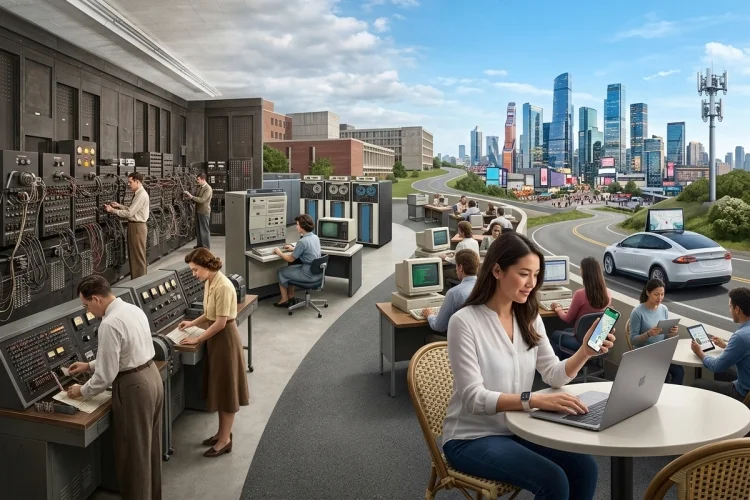
Today, we carry more computing power in our pockets than early computer engineers could have imagined. Smartphones can edit videos, translate languages, navigate cities, process payments, and connect us with people on the other side of the planet.
However, computers did not suddenly appear as slim laptops and touchscreen devices. Their development was a long journey involving mechanical calculators, punched cards, vacuum tubes, transistors, microchips, and countless experiments.
The history of computers from early machines to modern devices shows how people gradually learned to automate calculations and information processing. Each generation of technology made machines smaller, faster, cheaper, and easier to use.
Early computers could fill entire rooms while performing tasks that a basic calculator can now complete almost instantly. Modern computing devices, meanwhile, fit inside watches, cars, home appliances, and medical equipment.
Understanding the history of computers is not only about remembering old machines. It also helps us see how innovation builds on earlier ideas – and where computer technology may go next.
From Counting Tools to Mechanical Calculators
The basic idea behind computing began with a simple human need: counting things accurately. Long before electricity, people used fingers, stones, tally marks, counting boards, and devices such as the abacus to keep track of numbers.
As trade, navigation, science, and government became more complicated, people needed faster and more dependable ways to calculate. Mechanical calculators were eventually developed using wheels, gears, and levers.
Machines created during the 17th century could perform basic mathematical operations. They were limited compared with modern computers, but they introduced an important concept: a machine could follow a physical process to produce a numerical result.
The word “computer” originally referred to a person who performed calculations. Human computers created mathematical tables for astronomy, engineering, banking, and navigation. Unfortunately, even a small error could cause serious problems.
This need for accurate, automated calculations encouraged inventors to design machines that could do more than simple arithmetic.
Charles Babbage and the Idea of a Programmable Computer
One of the most important figures in early computer history was English mathematician Charles Babbage. In the 1820s, he designed the Difference Engine to calculate and print mathematical tables automatically.
A working section containing roughly 2,000 parts was completed in 1832, although the full machine was never built during his lifetime. The design used mechanical gears rather than electricity, but it represented a major step toward automatic calculation.
Babbage later designed a more ambitious device called the Analytical Engine. Unlike the Difference Engine, which was created for a specific type of calculation, the Analytical Engine was intended to solve many different mathematical problems.
A Design Surprisingly Similar to Modern Computers
The Analytical Engine included a “store” for holding numbers and a “mill” for processing them. These ideas are surprisingly similar to the separation between memory and the processor in modern computers.
The machine would have been programmed using punched cards inspired by those used to control patterns in Jacquard weaving looms. Although it was never completed, its design contained several important features of a general-purpose computer.
Mathematician Ada Lovelace studied Babbage’s plans and described how the engine could follow a sequence of instructions. She also imagined that computers might manipulate symbols, music, and other information—not only numbers.
Her ideas were far ahead of their time and helped establish the concept of computer programming.
Electronic Computers Change Everything
Mechanical and electromechanical machines continued to develop during the early 20th century. However, World War II created an urgent demand for machines that could calculate faster.
Engineers began building computers that used electrical relays and vacuum tubes. Vacuum tubes could control electronic signals much more quickly than mechanical switches, but they consumed a lot of electricity, produced considerable heat, and frequently failed.
One of the best-known early electronic computers was ENIAC, or Electronic Numerical Integrator and Computer. Built by John Mauchly and J. Presper Eckert at the University of Pennsylvania, it was publicly unveiled in 1946.
ENIAC occupied more than 1,000 square feet, weighed around 30 tons, and contained approximately 18,000 vacuum tubes. Despite its enormous size, it was over 1,000 times faster than earlier electromechanical computers.
Programming ENIAC was very different from installing an app today. Operators had to adjust switches and physically reconnect cables to prepare it for a new problem.
Later machines adopted the stored-program concept, allowing both instructions and data to be kept in electronic memory. This made computers much more flexible and reduced the need to rewire them manually.
Transistors and Integrated Circuits Make Computers Smaller
Vacuum tubes allowed electronic computing to grow, but they were not practical for smaller and more reliable machines. The invention of the transistor provided a better solution.
In 1947, John Bardeen and Walter Brattain created a semiconductor amplifier at Bell Laboratories, and William Shockley helped develop the technology further. The component became known as the transistor.
Transistors performed many of the switching and amplifying jobs of vacuum tubes while using less power and producing less heat. They were also smaller, more durable, and more reliable.
During the 1950s and 1960s, transistor-based computers began replacing vacuum-tube systems. Computers still remained expensive, but they became practical for more businesses, universities, scientific laboratories, and government agencies.
The next major development was the integrated circuit. Instead of connecting individual electronic components separately, manufacturers could place multiple components on a small piece of semiconductor material.
Integrated circuits reduced the physical size and production cost of computers. As more components were placed on a single chip, computing power increased dramatically.
Microprocessors Bring Computers to the Desktop
The microprocessor marked another turning point in the evolution of computer technology. It placed the main processing functions of a computer onto a single chip.
Intel introduced the 4004 microprocessor in 1971. It began as part of a project for Japanese calculator manufacturer Busicom, but its programmable, general-purpose design had much wider potential.
Microprocessors made it possible to build much smaller and more affordable computers. During the 1970s, computer kits and early home machines attracted hobbyists who wanted to experiment with programming.
Products such as the Apple II helped turn the personal computer into a practical device for homes, schools, and small businesses. Users could play games, write programs, manage information, and perform calculations without accessing a large corporate mainframe.
In 1981, IBM introduced the IBM Personal Computer, commonly known as the IBM PC. Its open architecture encouraged outside companies to develop compatible software, expansion cards, and eventually entire IBM-compatible computers.
Within one year, more than 750 software packages were available for the IBM PC. Its design became an industry standard, and “PC” gradually became a general term for personal computers.
Graphical Interfaces and the Internet Expand Computer Use
Early personal computers relied heavily on text commands. Users often needed to memorize specific instructions just to open files or run programs.
Graphical user interfaces made computers more approachable by introducing windows, icons, menus, and pointers. The computer mouse allowed people to interact visually instead of typing every command.
During the 1980s and 1990s, personal computers became common in workplaces, schools, and homes. Word processors replaced many typewriters, spreadsheets simplified business calculations, and digital databases transformed recordkeeping.
Networking then changed computers from isolated machines into communication tools. The Internet connected different computer networks, while the World Wide Web made online information easier to access.
Tim Berners-Lee invented the Web while working at CERN in 1989. By the end of 1990, the first web server and browser were operating at CERN, combining computers, data networks, and hypertext into a global information system.
Web browsers, search engines, email services, and online communities soon changed how people learned, worked, shopped, and communicated.
From Laptops to Smartphones and Cloud Computing
As processors became more efficient, computers no longer had to stay on desks. Laptops gave users portable access to software, documents, entertainment, and the Internet.
Mobile phones also evolved into powerful computing platforms. When Apple introduced the iPhone in January 2007, it combined a mobile phone, media player, web browser, email system, maps, and a multi-touch interface in one handheld device.
Smartphones were not the first mobile computers, but their growing popularity helped make touchscreen computing part of everyday life. Modern phones now include multicore processors, high-resolution cameras, biometric sensors, GPS, and advanced graphics capabilities.
Cloud computing has further changed how devices operate. Instead of storing and processing everything locally, users can access applications, files, and computing resources through remote data centers.
This means a lightweight laptop or phone can use powerful online services for video editing, gaming, data storage, translation, and collaboration.
Computers are also embedded in cars, televisions, factories, medical devices, security systems, and household appliances. Many people interact with dozens of computers every day without thinking of them as computers.
Modern Computing, Artificial Intelligence, and the Future
Modern computing is increasingly shaped by artificial intelligence. AI systems can recognize images, understand speech, generate text, recommend content, and analyze enormous datasets.
Specialized processors, including graphics processing units and neural processing units, help devices perform AI-related tasks more efficiently. Some processing happens in cloud data centers, while newer phones and laptops can run certain AI features directly on the device.
Quantum computing is another developing field. Instead of using only conventional binary bits, quantum computers use quantum bits, or qubits, to approach certain specialized problems differently.
Quantum machines are not expected to replace ordinary computers for everyday activities. However, researchers hope they may eventually support scientific simulation, material discovery, optimization, and other highly complex tasks.
The future of computers will probably involve smaller hardware, more natural interfaces, stronger connectivity, and increasingly intelligent software. Privacy, cybersecurity, energy consumption, and responsible AI use will also become more important as computers influence more parts of human life.
The history of computers stretches from simple counting tools and mechanical gears to room-sized electronic machines, personal computers, smartphones, cloud platforms, and artificial intelligence.
Innovations such as Babbage’s Analytical Engine, electronic vacuum-tube computers, transistors, integrated circuits, and microprocessors each moved computing forward. Over time, computers became smaller, faster, more affordable, and much easier to use.
Modern devices may look completely different from early calculating machines, but they are built on many of the same basic ideas: storing information, following instructions, and processing data.
Take a closer look at the devices around you and consider how many are actually computers. Learning about their history is one of the best ways to understand the digital world—and prepare for whatever comes next.