Look at the night sky and you might see hundreds or thousands of stars, depending on where you live. It is easy to imagine those stars scattered randomly through space, but they actually belong to something far larger: a galaxy.
Our Sun is only one star inside the Milky Way, a gigantic cosmic system containing at least 100 billion stars. And the Milky Way itself is just one galaxy among an almost unimaginable number spread throughout the observable universe.
So, what is a galaxy and how many galaxies are there?
A galaxy is essentially an enormous collection of stars, planets, gas, dust, and dark matter held together by gravity. Galaxies can be small and faint or enormous systems containing trillions of stars.
Counting them, however, is much harder than defining them. Some are incredibly distant, while others are too faint for current telescopes to detect directly.
Depending on how scientists estimate the unseen population, the observable universe may contain hundreds of billions – and possibly around two trillion – galaxies.
What Exactly Is a Galaxy?
A galaxy is a gravitationally bound collection of stars, gas, dust, planets, stellar remnants, and large amounts of dark matter.
NASA describes galaxies as concentrations of stars, gas, dust, and dark matter that come in many shapes and sizes. Some of the largest contain trillions of stars and can stretch for more than a million light-years.
Gravity is what keeps all these components together.
Stars orbit through galaxies just as planets orbit stars, although galactic motion is much more complicated. A galaxy also contains large regions where new stars form from clouds of gas and dust.
Dark matter plays another important role.
Scientists cannot observe dark matter directly because it does not emit or reflect light. However, its gravitational effects strongly influence how stars and gas move through galaxies. NASA estimates that dark matter makes up most of the matter in a typical galaxy.
So a galaxy contains far more than the beautiful stars we can actually see.
What Are the Main Types of Galaxies?
Galaxies come in many shapes, but astronomers commonly group them into three broad categories: spiral, elliptical, and irregular.
1. Spiral Galaxies
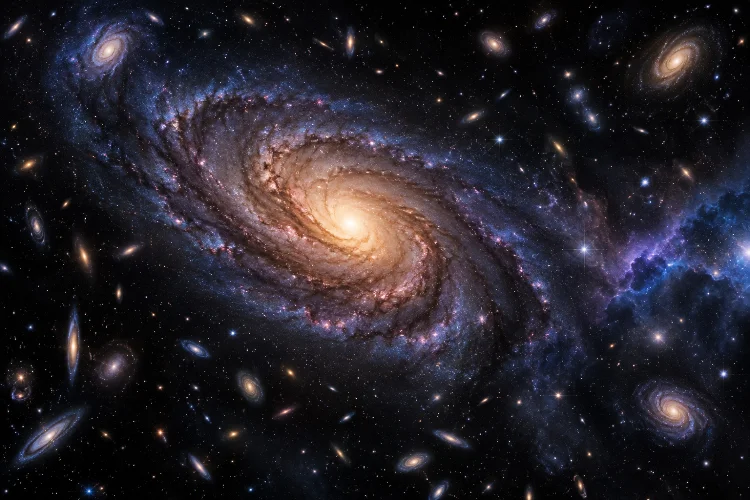
Spiral galaxies resemble enormous rotating pinwheels.
They usually contain a flattened disk, a central bulge, and curved spiral arms filled with stars, gas, and dust. The arms are often active regions of star formation.
Our own Milky Way is a barred spiral galaxy, meaning it has a bar-shaped concentration of stars running through its central region. The nearby Andromeda Galaxy also belongs to the broader spiral category.
2. Elliptical Galaxies
Elliptical galaxies look more rounded or oval.
They often contain large populations of older stars and much less cold gas and dust than spiral galaxies. As a result, many elliptical systems form fewer new stars.
Some are relatively small, while giant ellipticals can become among the largest galaxies known.
3. Irregular Galaxies
Irregular galaxies have no obvious spiral or elliptical structure.
Some have been distorted by interactions or collisions with other galaxies. Others may simply be relatively small systems without a highly organized shape.
Together, these categories help astronmers understand how galaxies form and evolve.
Where Is Our Milky Way Galaxy?
Earth sits inside the Milky Way Galaxy.
Our solar system is located far from the galactic center, inside the disk of the Milky Way. Because we are viewing our galaxy from within it, we cannot simply take a photograph showing the entire structure from the outside.
Instead, astronomers map the positions and movements of stars, gas, and dust to reconstruct its overall shape.
NASA estimates that the Milky Way contains at least 100 billion stars.
The galaxy also contains a supermassive black hole called Sagittarius A* near its center.
The Milky Way is not alone.
It belongs to a gravitationally associated collection of nearby galaxies called the Local Group, which also includes Andromeda and many smaller dwarf galaxies.
On even larger scales, galaxies gather into clusters, superclusters, filaments, and enormous cosmic structures separated by relatively empty regions called voids.
How Do Galaxies Form?
Galaxies did not appear fully formed immediately after the Big Bang.
In the early universe, matter was distributed much more smoothly. Gravity gradually pulled denser regions together, eventually creating the conditions in which the first generations of stars and galaxies could develop.
Dark matter appears to have been especially important because its gravity provided a framework into which ordinary matter could collect.
Galaxies then changed through billions of years of star formation, gas accretion, interactions, and mergers.
Small galaxies can combine to produce larger systems. Even large galaxies continue to interact.
Our own Milky Way and Andromeda, for example, are moving toward one another and are expected to interact in the distant future.
This means galaxies are not permanent, unchanging structures.
They grow, collide, consume smaller systems, form new stars, and gradually evolve over cosmic time.
How Do Scientists Count Galaxies?
This is where the question becomes complicated.
Astronomers cannot simply point a telescope at the sky and count every galaxy in existence.
Instead, they observe small sections of the sky very deeply and use those observations to estimate the larger population.
One famous example is the Hubble Ultra Deep Field.
The Hubble Space Telescope spent long periods observing a tiny patch of apparently empty sky. The resulting image revealed roughly 10,000 galaxies in an area only a tiny fraction of the entire sky.
Some of those galaxies are extremely distant.
Because light takes time to travel, observing a galaxy billions of light-years away also means seeing it as it existed billions of years ago.
Astronomers can therefore use deep-field observations almost like a cosmic history book.
The challenge is that telescopes still miss extremely small, faint, or distant galaxies.
Scientists must use statistical models to estimate how many invisible systems are likely to exist beyond current detection limits.
So, How Many Galaxies Are There?
There is no exact confirmed number.
NASA states that the observable universe contains at least 100 billion galaxies.
For many years, estimates of around 100-200 billion were commonly quoted.
Then a 2016 study using Hubble observations and mathematical modeling suggested that earlier estimates could be far too low. Researchers concluded that the observable universe might contain around two trillion galaxies – roughly ten times earlier estimates.
However, there is an important detail.
The two-trillion figure does not mean astronomers have individually photographed two trillion galaxies.
The study estimated that roughly 90% of the galaxy population could be too faint or distant to detect with the telescopes available at that time. The number therefore depends heavily on models used to extrapolate beyond directly observed galaxies.
NASA has also cautioned that later measurements of the universe’s background light do not directly determine the total number of galaxies.
A sensible answer is therefore: we know there are at least hundreds of billions of galaxies in the observable universe, while some estimates suggest the true population could approach two trillion.
Why Is It So Difficult to Know the Exact Number?
Distance is one major problem.
A distant galaxy becomes increasingly faint, making small systems especially difficult to detect. Dust, cosmic expansion, telescope sensitivity, and the wavelength being observed also affect what astronomers can see.
There is another complication: galaxies change over time.
The early universe may have contained many small galaxies that later merged into larger systems. A census of galaxies billions of years ago could therefore produce a different number from a census of the universe today.
The definition of a galaxy can also become complicated at the smallest scales.
Large galaxies are obvious, but extremely faint dwarf systems can sometimes be difficult to distinguish from large star clusters.
This is why scientists usually talk about estimated populations rather than claiming one perfect cosmic total.
And there is an even bigger limitation: astronomers are discussing the observable universe.
There may be vastly more space beyond the region whose light has had time to reach us.
Galaxies Can Contain Incredible Numbers of Stars
The enormous number of galaxies makes the scale of the universe difficult to imagine.
The Milky Way alone contains at least 100 billion stars. Other giant galaxies can contain more than a trillion.
Many of those stars probably have planets.
NASA notes that if the observable universe contains at least 100 billion galaxies and galaxies contain enormous numbers of stars, the total stellar population reaches staggering numbers.
Even then, stars are only part of the picture.
Galaxies contain planets, black holes, neutron stars, nebulae, gas clouds, dust, and huge quantities of misterious dark matter.
Between galaxies lies even more space.
The universe is therefore not simply “full of stars.” It is structured into enormous gravitational systems arranged across a cosmic web spanning billions of light-years.
Why Studying Galaxies Matters
Galaxies allow scientists to study the history of the universe.
Looking at nearby galaxies reveals how stars form and how galactic structures behave today. Looking at extremely distant galaxies lets researchers investigate much earlier periods of cosmic history.
Hubble transformed this research by observing deep fields and distant galaxies.
The James Webb Space Telescope is now extending these observations, studying extremely distant systems whose light began traveling toward us when the universe was very young.
Galaxy research also helps scientists investigate some of astronomy’s biggest questions.
How did the first stars form? How did supermassive black holes grow? What is dark matter? Why is cosmic expansion accelerating?
Galaxies act like giant laboratories for studying all of these questions.
As telescope technology improves, our estimate of how many galaxiess exist – and our understanding of what those galaxies look like – will continue to change.
So, what is a galaxy and how many galaxies are there?
A galaxy is an enormous gravitational system containing stars, planets, gas, dust, dark matter, and often a supermassive black hole. They range from small dwarf galaxies to gigantic structures containing trillions of stars.
Our Milky Way is just one example.
Current observations show that the observable universe contains at least hundreds of billions of galaxies, while Hubble-based modeling has suggested the total population could reach roughly two trillion when extremely faint systems are included.
The exact number remains uncertain because many galaxies are simply too distant or faint to observe directly.
Next time you look at a single star in the night sky, remember that our entire galaxy is only one small part of a universe filled with billions upon billions of other cosmic islands.