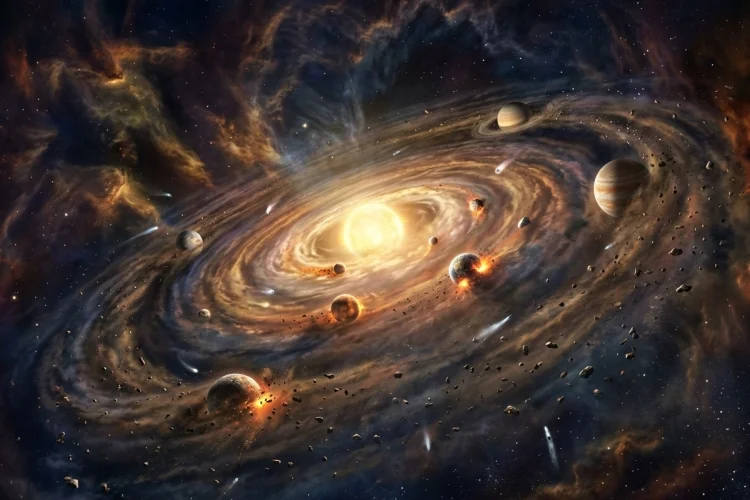
Our solar system is home to eight remarkably different planets. Some are small, rocky worlds with solid ground, while others are enormous balls of gas and fluid with storms larger than Earth.
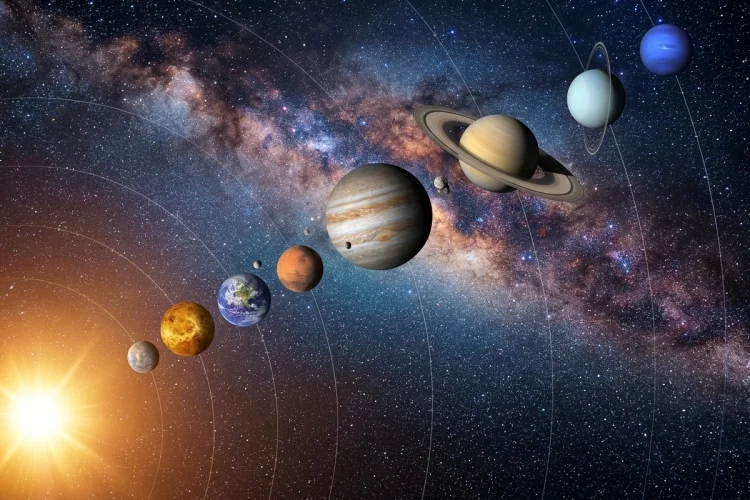
One has comfortable oceans and living creatures; another is hot enough to melt lead. The planets appear in a clear order moving outward from the Sun: Mercury, Venus, Earth, Mars, Jupiter, Saturn, Uranus, and Neptune.
Although illustrations often show them sitting close together, the real distances between their orbits are enormous. This guide to the eight planets in our solar system explores what makes each world special, from Mercury’s extreme temperatures to Neptune’s powerful winds.
It also explains the difference between rocky planets, gas giants, and ice giants – and why Pluto is no longer included on the main planetary list. Together, these worlds reveal how varied planets can become even when they form around the same star.
What Makes an Object a Planet?
The International Astronomical Union uses three main conditions to define a planet in our solar system. The object must orbit the Sun, have enough gravity to become nearly round, and clear most other large objects from the area around its orbit.
Our eight planets fall into two broad groups. Mercury, Venus, Earth, and Mars are terrestrial planets with solid, rocky surfaces.
Jupiter and Saturn are gas giants, while Uranus and Neptune are called ice giants because their interiors contain larger amounts of materials such as water, methane, and ammonia.
The Four Rocky Inner Planets
The inner planets orbit relatively close to the Sun. They are smaller than the outer worlds and are mainly made of rock and metal.
1. Mercury: The Smallest and Fastest Planet
Mercury is the closest planet to the Sun and the smallest of the eight planets. It completes an orbit in only 88 Earth days, making its year shorter than that of any other world.
Despite being nearest to the Sun, Mercury is not the hottest planet because it has almost no atmosphere to trap heat. Daytime temperatures can reach about 430°C, while nighttime temperatures may fall to around -180°C.
Mercury also rotates slowly. One complete solar day – from one sunrise to the next – lasts 176 Earth days. Its cratered surface gives it an appearance similar to Earth’s Moon.
2. Venus: Earth’s Extremely Hot Twin
Venus is close to Earth in size and structure, which is why it is sometimes called our sister planet. However, the conditions on its surface are completely different.
A dense carbon dioxide atmosphere creates an intense runaway greenhouse effect. Its average surface temperature is about 467°C, making Venus hotter than Mercury despite being farther from the Sun. Surface pressure is also around 93 times greater than pressure at sea level on Earth.
Venus rotates very slowly and in the opposite direction from most planets. One rotation takes 243 Earth days, which is longer than its 225-day journey around the Sun.
3. Earth: The Ocean Planet
Earth is the third planet from the Sun and the largest of the four terrestrial worlds. It is the only planet currently known to support life.
Liquid water covers about 71 percent of its surface, while its atmosphere, magnetic field, and suitable distance from the Sun help maintain habitable conditions. Earth also has active plate tectonics, changing weather, and an enormous variety of ecosystems.
Our planet rotates once in approximately 23.9 hours and takes about 365.25 days to orbit the Sun. That extra quarter day is why calendars include a leap day roughly every four years. Earth has one natural satellite, the Moon, which probably formed after a massive collision early in the planet’s history.
4. Mars: The Red Planet
Mars is the fourth planet from the Sun and roughly half as wide as Earth. Iron minerals in its soil have oxidized, or rusted, giving the surface its familiar reddish color.
A Martian day lasts 24.6 hours, making it surprisingly similar to an Earth day. Its year, however, lasts 687 Earth days. Mars also experiences seasons because its rotational axis is tilted in a way similar to Earth’s.
Today, Mars is cold and dry, with a thin atmosphere made mainly of carbon dioxide. Evidence gathered by spacecraft suggests that the planet was warmer and wetter billions of years ago, with rivers, lakes, and possibly long-lasting bodies of water. It has two small moons, Phobos and Deimos.
The Four Giant Outer Planets
Beyond Mars and the main asteroid belt are four much larger planets. These worlds do not have solid surfaces where a spacecraft could simply land. Their visible exteriors consist of deep, swirling atmospheres surrounding increasingly dense interiors.
5. Jupiter: The Largest Planet
Jupiter is the fifth planet from the Sun and the largest planet in the solar system. It is so massive that it contains more than twice as much material as all the other planets combined.
The planet is mostly made of hydrogen and helium. Its colorful bands are produced by powerful atmospheric currents, while its famous Great Red Spot is a gigantic, long-lasting storm.
Jupiter also rotates faster than any other planet. One day lasts only about 9.9 hours, while one orbit around the Sun takes almost 12 Earth years. Its strong gravity controls a large family of moons, including Io, Europa, Ganymede, and Callisto.
6. Saturn: The Ringed Giant
Saturn is the sixth planet from the Sun and the second largest after Jupiter. It is another gas giant composed mostly of hydrogen and helium.
Its spectacular rings are made from billions of pieces of ice, dust, and rock. Some particles are smaller than grains of sand, while others may be as large as houses or mountains. Although the ring system spreads across a huge distance, its main sections are surprisingly thin.
A day on Saturn lasts about 10.7 hours, but one Saturnian year equals approximately 29.4 Earth years. The planet also has a large collection of moons, including Titan, which has a thick atmosphere, and Enceladus, which sprays water-rich material into space.
7. Uranus: The Planet That Spins Sideways
Uranus is the seventh planet from the Sun and the first planet discovered using a telescope. It is classified as an ice giant rather than a gas giant.
Its most unusual feature is its extreme axial tilt of nearly 98 degrees. Instead of rotating mostly upright, Uranus appears to roll around the Sun on its side. Scientists think a major collision early in its history may have produced this strange orientation.
One day lasts approximately 17 hours, while a full orbit takes 84 Earth years. Uranus also has faint rings and numerous small moons. Methane in its atmosphere absorbs red light and contributes to the planet’s pale blue-green appearance.
8. Neptune: The Distant, Windy World
Neptune is the eighth and farthest major planet from the Sun. It orbits at an average distance of about 4.5 billion kilometers, roughly 30 times farther from the Sun than Earth.
Although Neptune receives very little sunlight, it has an extremely active atmosphere. Winds can exceed 2,000 kilometers per hour, making it the windiest planet in the solar system.
The planet takes around 165 Earth years to complete one orbit. It was discovered in 1846 after mathematicians predicted its location by studying unexplained changes in Uranus’s orbit.
Voyager 2 remains the only spacecraft to have visited Neptune closely, flying past it in 1989.
How Do the Eight Planets Compare?
The differences between the planets are enormous. Mercury is the smallest, while Jupiter is the largest. Venus is the hottest, even though Mercury is closer to the Sun. Earth is the only known living world, and Mars is currently the most heavily explored planet beyond our own.
Jupiter and Saturn are mainly made of gas, while Uranus and Neptune contain a higher proportion of heavier icy materials. All four giant planets have rings, but Saturn’s are by far the brightest and easiest to recognize.
Distance also changes the length of a planet’s year. Mercury races around the Sun in 88 days, while Neptune requires approximately 165 Earth years to complete the same basic journey.
Why Is Pluto Not One of the Eight Planets?
Pluto was considered the ninth planet for decades. In 2006, however, the International Astronomical Union classified it as a dwarf planet.
Pluto orbits the Sun and is round, but it has not cleared other objects from its orbital neighborhood. It shares its region with many icy bodies in the Kuiper Belt.
This classification does not mean Pluto disappeared or became scientifically unimportant. It remains a fascinating world with mountains, glaciers, a thin atmosphere, and several moons.
It simply belongs to a different category alongside recognized dwarf planets such as Ceres, Eris, Haumea, and Makemake.
The eight planets in our solar system form an amazingly diverse family. Mercury is small and scorched, Venus is wrapped in a crushing atmosphere, Earth supports life, and Mars preserves evidence of a wetter past.
Farther out, Jupiter dominates in size, Saturn displays its icy rings, Uranus rotates sideways, and Neptune experiences the solar system’s fastest planetary winds.
Learning about these worlds helps scientists understand how planets form and evolve. It also provides clues about thousands of planets discovered around other stars.
The next time you look at the night sky, try identifying Venus, Mars, Jupiter, or Saturn. Even a small telescope or astronomy app can turn this planetary guide into a real tour of our cosmic neighborhood.