Around 4.6 billion years ago, there was no Earth, no Moon, and no familiar line of planets circling the Sun. Our corner of space was filled with a vast cloud of cold gas and microscopic dust.
Somehow, part of that cloud collapsed, creating a young star surrounded by a swirling disk of leftover material.
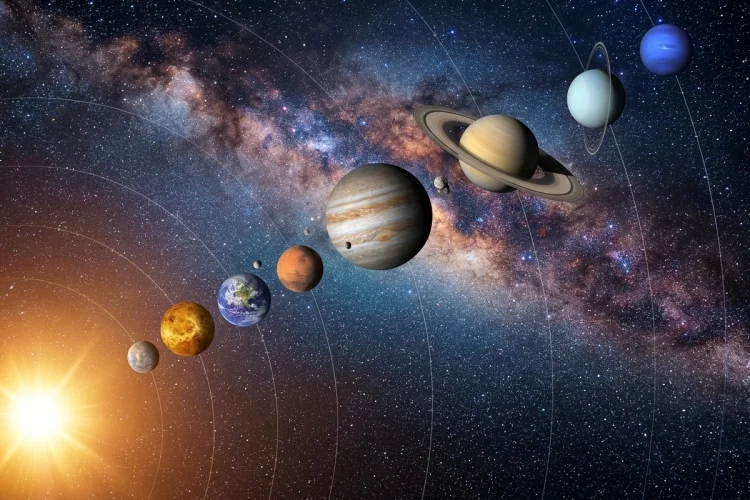
From that messy beginning came everything in our planetary neighborhood: the rocky inner worlds, giant outer planets, moons, asteroids, comets, and countless smaller objects.
The process was not quick or peaceful. Dust grains collided, growing worlds smashed into one another, and gravity continuously reshaped their orbits.
So, how was the solar system formed? Scientists explain its birth through the nebular theory, supported by meteorites, spacecraft samples, computer models, and observations of planet-forming disks around young stars.
The broad story is well established, although researchers are still investigating exactly how the earliest particles became planets and how those planets moved into their current positions.
The Short Answer: Everything Began With a Nebula
The solar system formed from a portion of a giant molecular cloud containing mostly hydrogen and helium, along with dust and heavier elements produced by earlier generations of stars.
These older stars had released materials such as carbon, oxygen, silicon, and iron into space before the Sun was born. Gravity caused a dense region of this cloud to collapse.
Scientists do not know exactly what triggered the collapse. It may have happened naturally as the cloud became unstable, although a shock wave from a nearby stellar event is sometimes discussed as a possible trigger.
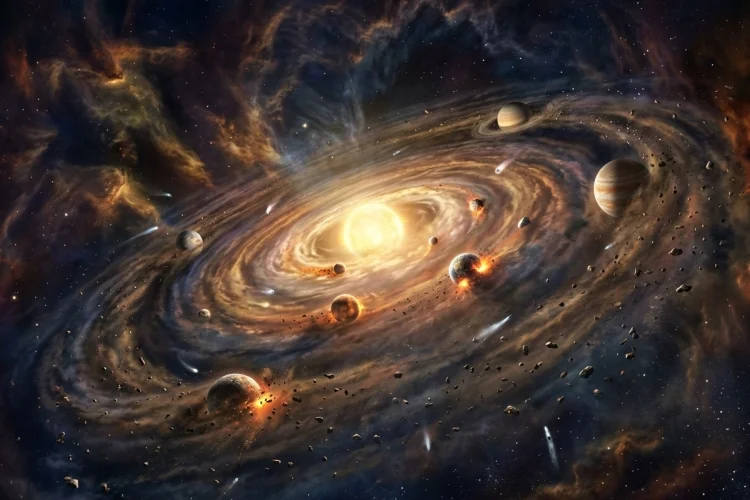
As the material fell inward, it began rotating faster. The cloud gradually flattened into a wide disk called the solar nebula, with most of its matter collecting near the center.
The Sun Formed at the Center of the Disk
The center of the collapsing nebula became increasingly dense, hot, and pressurized. It first developed into a protostar – a young object that had not yet begun normal hydrogen fusion.
More material continued falling toward the center until the temperature and pressure became high enough for hydrogen nuclei to combine into helium. This process, called nuclear fusion, released enormous amounts of energy and marked the birth of the Sun.
The Sun collected about 99.8 percent of the solar system’s total mass. The remaining fraction stayed in the rotating disk, where it eventually produced every planet, moon, asteroid, and comet in our system.
The disk shape also explains why the major planets orbit in roughly the same direction and within a relatively flat plane. They developed from material moving around the young Sun in the same spinning structure.
Dust Grains Slowly Became Planetesimals
The material outside the newborn Sun began as gas, ice, mineral grains, and tiny pieces of dust. These particles frequently collided as they traveled through the protoplanetary disk.
Some collisions caused particles to bounce apart, but others allowed them to stick together through electrical forces and surface interactions. Small clumps gradually became pebbles, larger rocks, and eventually bodies measuring kilometers across.
These early building blocks are known as planetesimals. Once they became large enough, their gravity attracted additional material, allowing them to grow more quickly.
Planetesimals collided and combined into larger planetary embryos, also called protoplanets. The process of building bigger objects through repeated collisions and gravitational attraction is known as accretion.
Researchers continue studying exactly how particles passed through every growth stage, particularly the difficult transition from small pebbles to large planetesimals.
Why the Inner and Outer Planets Are So Different
The young solar system had a major temperature difference between its inner and outer regions. Close to the Sun, conditions were too hot for materials such as water, methane, and ammonia to remain frozen.
Only heat-resistant substances, including metals and rocky minerals, could easily become solid in the inner disk. This is why Mercury, Venus, Earth, and Mars developed as relatively small, dense, rocky planets.
Farther from the Sun was a colder boundary commonly called the snow line or frost line. Beyond it, water and other volatile compounds could freeze, providing much more solid material for growing planets.
The Giant Planets Grew Farther Out
Large planetary cores formed in the cooler outer disk. Jupiter and Saturn became massive enough to attract thick envelopes of hydrogen and helium before the surrounding gas disappeared.
Uranus and Neptune also collected significant amounts of gas, but they contain larger proportions of water, ammonia, methane, and other heavier materials. For this reason, they are usually described as ice giants rather than gas giants.
The formation of planets took millions of years. Rocky worlds may have continued growing through major collisions for tens of millions of years after the young Sun appeared.
Early Planetary Collisions Reshaped the System
The early solar system was not arranged as neatly as it is today. It contained numerous protoplanets moving through crowded and sometimes unstable orbits.
Some objects merged, while others were shattered, thrown into distant regions, or ejected from the solar system entirely. The surviving planets grew by collecting part of this material, but their impacts could be extremely violent.
Scientists think Earth’s Moon formed after a Mars-sized object struck the young Earth. Material blasted into orbit gathered into a disk and eventually combined to create the Moon.
Evidence from Apollo rock samples supports a large-impact origin, with current estimates placing the event around 60 million years after solar system formation began.
Collisions also influenced planetary rotation, surface composition, and internal heating. Large impacts helped melt young worlds, allowing heavy metals to sink toward their centers while lighter rocky material formed their outer layers.
Asteroids and Comets Are Leftover Building Materials
Not all material in the protoplanetary disk became part of a planet. Asteroids, comets, and meteoroids preserve remnants from the solar system’s construction period.
The asteroid belt between Mars and Jupiter is not simply the remains of one exploded planet. Its rocky and metallic objects are largely leftover material that never successfully combined into a major world. Jupiter’s strong gravitational influence helped prevent stable planetary growth in that region.
Comets formed mainly in colder parts of the solar system and contain ice, dust, rock, and organic compounds. Many now occupy distant regions such as the Kuiper Belt, while others are thought to exist much farther away in the enormous Oort Cloud.
These small bodies are scientifically valuable because many have experienced less geological change than planets. They preserve ancient material that can reveal what conditions were like when the Sun and planets were young.
How Did Earth Become a Habitable Planet?
Earth began as a hot, frequently bombarded rocky world. As it grew, impacts, gravitational compression, and radioactive elements produced enough heat to melt much of its interior.
Over time, Earth separated into layers, including a metallic core, rocky mantle, and outer crust. Gases released from its interior helped form an early atmosphere, while water accumulated at the surface as conditions cooled.
Scientists are still investigating where all of Earth’s water came from. Some was probably present in the material that built the planet, while water-rich asteroids and possibly comets may have delivered additional amounts through impacts.
Earth’s final habitability resulted from many factors, including its distance from the Sun, long-term water supply, atmosphere, internal geology, magnetic field, and relatively stable orbit.
Planet formation created the world, but billions of years of geological and biological evolution shaped the environment we know today.
What Evidence Supports the Formation Theory?
Scientists cannot travel back 4.6 billion years to watch the solar system form, but they can examine evidence left behind.
Meteorites are among the most important clues. Many contain material dating back as far as 4.6 billion years, allowing researchers to estimate the solar system’s age and study its earliest chemical ingredients.
Space missions also collect samples from asteroids, comets, the Moon, and the solar wind. These materials reveal chemical and isotopic patterns that help researchers reconstruct conditions inside the ancient solar nebula.
Astronomers can also observe young stars surrounded by protoplanetary disks. Some disks contain rings, gaps, and other structures that may be produced by growing planets.
These systems do not show our own past directly, but they demonstrate that stars and planets are forming through similar processes elsewhere in the galaxy.
Is the Solar System Finished Forming?
The major planets have existed for billions of years, but the solar system is not completely static. Asteroids still collide, comets continue entering the inner system, and small objects occasionally strike planets and moons.
Planetary orbits also change slightly through gravitational interactions. The Sun itself is moving through the Milky Way while carrying the entire planetary system with it.
However, the chaotic construction period is over. Most available material has already been collected, scattered, or removed, leaving the relatively stable system we observe today.
Studying this history also helps astronomers understand planets around other stars. By comparing our system with young disks and mature exoplanet systems, researchers can learn which parts of our planetary story are common and which may be unusual.
The solar system formed about 4.6 billion years ago when gravity collapsed part of a giant cloud of gas and dust. The Sun developed at its center, while leftover material flattened into a spinning protoplanetary disk.
Dust became planetesimals, planetesimals grew into protoplanets, and repeated collisions produced the planets and moons.
Heat near the Sun favored small rocky worlds, while colder conditions farther away allowed giant planets to form. Asteroids and comets remain as ancient leftovers from this enormous construction project.
The next time you look at a planet, meteor, or full Moon, remember that you are seeing a surviving part of the same cosmic story. Explore NASA’s mission archives and images of protoplanetary disks to discover how scientists continue piecing that story together.