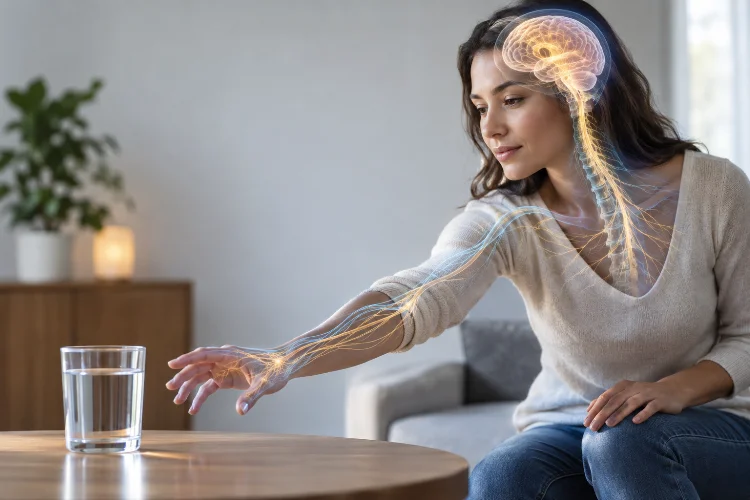
You decide to pick up a glass of water. Almost instantly, your eyes locate the glass, your brain calculates where it is, muscles in your shoulder and arm move, your fingers adjust their grip, and sensory nerves tell you whether you are holding it too tightly.
Most of this happens without you consciously thinking about every step.
So, how does the brain control the body?
The brain works as the central processing center of the nervous system. It receives information from sensory organs and nerves, interprets that information, and sends instructions back through the spinal cord and peripheral nerves.
These signals help control movement, balance, breathing, heartbeat, digestion, temperature, emotions, sleep, and many other functions.
But the brain does not work alone. The spinal cord, peripheral nerves, muscles, sensory organs, and endocrine system all contribute.
Rather than operating like one simple command center, the brain is more like a constantly communicating network that adjusts the body every second.
The Brain and Nervous System Work as a Team
The nervous system has two major divisions.
The central nervous system, or CNS, consists of the brain and spinal cord. The peripheral nervous system, or PNS, includes the nerves that extend throughout the rest of the body.
You can think of the brain as the main processing center, the spinal cord as a major communication highway, and peripheral nerves as the smaller roads reaching muscles, skin, organs, and sensory structures.
Information constantly travels in both directions.
Sensory nerves bring information toward the central nervous system. Motor nerves carry instructions away from it.
For example, when you touch a cold surface, sensory receptors detect the temperature and send signals toward the brain. Your brain interprets that information as cold and can then influence what you do next, such as moving your hand away.
This two-way communiction allows the body to continuously respond to changes inside and outside itself.
Neurons Carry the Brain’s Messages
The nervous system works through specialized cells called neurons.
A neuron receives, processes, and sends information. Signals generally travel electrically along a neuron’s axon before communication changes to a chemical process at the connection between cells, known as a synapse.
At many synapses, chemicals called neurotransmitters carry the message across the small gap between cells.
The receiving neuron can then continue the signal.
This communication happens extremely quickly across huge networks.
Different neurons perform different jobs. Sensory neurons deliver information from receptors toward the central nervous system, while motor neurons carry instructions that can make muscles contract.
Neurons also work alongside support cells called glia.
Glial cells perform important jobs such as protecting neurons, supporting them, regulating their environment, and creating myelin. Myelin acts as insulation around certain nerve fibers and helps electrical signals travel efficiently.
Together, these cells form the biological communication network behind almost everything your body does.
The Motor Cortex Helps Control Voluntary Movement
Suppose you want to raise your hand.
That apparently simple action involves multiple parts of the brain.
One important region is the motor cortex, located in the cerebrum.
The primary motor cortex has long been known to play a major role in controlling voluntary movements, although modern research shows that movement planning and coordination involve broader networks than one simple command area.
Once the brain prepares a movement, motor signals travel down pathways toward the spinal cord.
The spinal cord then helps carry those instructions toward peripheral nerves connected to muscles.
Motor neurons ultimately trigger muscle fibers to contract.
Interestingly, many major motor pathways cross sides as they pass between the brain and spinal cord. As a result, the left side of the brain has a major role in controlling the right side of the body, while the right hemisphere influences the left side.
The process happens so quickly that ordinary actions feel effortless.
But even reaching for a cup requires continuous calculations involving position, force, timing, and sensory feedback.
The Cerebellum Makes Movement Smooth and Accurate
The motor cortex may help initiate movement, but another brain region plays a major role in making that movement coordinated.
That region is the cerebellum.
Located toward the back and lower part of the brain, the cerebellum contributes to balance, posture, muscle coordination, fine movements, and motor learning.
Imagine trying to walk across a room.
Your brain needs to coordinate your legs, maintain your center of gravity, adjust your posture, and respond when one foot touches the floor differently than expected.
The cerebellum constantly compares intended movements with sensory feedback and helps make corrections.
This is why movements that require precision – such as writing, playing an instrument, catching a ball, or walking on uneven ground – depend heavily on good coordiation between multiple brain systems.
Practice also matters.
When you repeatedly perform a physical skill, nervous-system circuits adapt. Over time, complex movements can feel increasingly automatic because the brain becomes more efficient at controlling them.
The Brain Controls Functions You Never Think About
Not everything requires a conscious decision.
You normally do not need to remind yourself to breathe while sleeping or consciously order your heart to beat.
Many automatic functions are controlled through the autonomic nervous system and brain regions including the brainstem and hypothalamus.
The brainstem regulates several functions essential for survival. These include breathing, heart activity, blood-vessel control, swallowing, and other automatic processes.
The autonomic nervous system connects the central nervous system with internal organs.
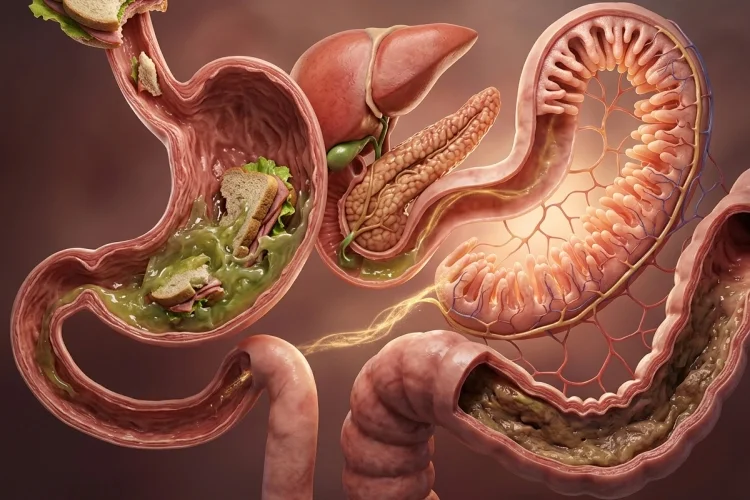
It influences processes such as heart rate, blood pressure, digestion, sweating, bladder activity, and pupil changes.
Sympathetic and Parasympathetic Responses
The autonomic nervous system includes major divisions that help the body respond to different situations.
Sympathetic activity becomes especially important during stress or physical demand. Heart rate may increase, blood flow can be redirected, and the body becomes prepared for action.
Parasympathetic activity generally supports functions associated with recovery, digestion, and energy conservation.
These systems constantly adjust rather than simply switching completely on or off.
That is why your heart can accelerate when you run and gradually slow after you stop without requiring conscious commands.
The Brain Constantly Receives Sensory Information
Controlling the body would be almost impossible without feedback.
The brain needs to know what is happening.
Sensory neurons collect information about light, sound, smell, taste, pressure, pain, heat, cold, and the position of different body parts.
Your eyes, for example, send visual information toward the brain.
The brain does not simply receive a photograph. Neural systems process features such as movement, shape, location, depth, and color to help construct your perception of the environment.
Touch works in a similar way.
If you pick up a fragile object, sensory receptors in your fingers provide feedback about pressure and texture. Your brain can then adjust muscle force to avoid dropping or crushing it.
Your nervous system also monitors the body’s internal environment.
Information about blood pressure, temperature, oxygen levels, digestion, and other conditions helps the brain regulate processes that maintain internal stability.
This continuous feedback loop is a major reason body control can be so precise.
Reflexes Can Act Before the Brain Fully Processes a Situation
The brain is powerful, but sometimes waiting for detailed brain processing would be too slow.
That is where reflexes become useful.
A reflex is a rapid automatic response to a stimulus. Some simple reflexes can be coordinated through circuits in the spinal cord rather than waiting for full conscious processing in the brain.
Imagine accidentally touching something extremely hot.
Sensory neurons quickly carry a danger signal toward the spinal cord. Spinal circuits can activate motor neurons that pull your hand away.
Information still travels to the brain, which allows you to consciously experience the heat or pain.
But the protective movement can begin before that conscious experience is fully processed.
This design saves precious time.
Reflexes demonstrate that body control is distributed across the nervous system rather than every tiny command being managed directly by conscious thought.
The Hypothalamus Connects the Brain With Hormones
The brain also controls the body through chemistry.
One of the most important regions involved is the hypothalamus.
The hypothalamus helps connect the nervous system with the endocrine system, which uses hormones to regulate body processes.
It influences the pituitary gland and is involved in functions such as body temperature, appetite, fluid balance, autonomic regulation, and hormone control.
The nearby pituitary gland releases hormones that directly affect organs or regulate other hormone-producing glands.
This gives the brain another communication system.
Nerve signals can produce very rapid responses, while hormones can create effects that develop more gradually and last longer.
Consider stress.
The brain can quickly activate autonomic pathways that increase heart rate. It can also trigger hormonal systems involving glands such as the adrenal glands, producing broader physical changes.
The nervous and endocrine systems are therefore not completely seperate.
They constantly cooperate.
The Brain Also Maintains the Body’s Internal Balance
Your internal environment needs to stay within relatively narrow limits.
Body temperature, water balance, blood pressure, energy availability, and many other conditions must be regulated.
This stability is known as homeostasis.
The hypothalamus is particularly important in this process.
It receives information from different parts of the brain and body and helps coordinate responses involving behavior, autonomic nerves, and hormones.
For example, systems in the hypothalamus participate in temperature regulation. When the body becomes too warm, responses can promote heat loss. When it becomes cold, the nervous system can trigger mechanisms that conserve or generate heat.
Hunger and thirst also involve signals connecting the brain with the rest of the body.
This means even feelings that seem simple – such as suddenly wanting water – can reflect complex biological monitoring happening behind the scenes.
The brain is not merely controlling muscles.
It is continuously helping keep the body’s internal conditions compatible with survival.
Different Brain Regions Work Together
It is tempting to imagine each brain region having one fixed job.
Reality is more complicated.
The cerebrum contributes to movement, sensory processing, language, memory, thought, and many other functions. The cerebellum contributes strongly to movement and balance.
The brainstem supports essential automatic functions, while the hypothalamus helps coordinate internal regulation and hormones.
But these regions operate as interconnected networks.
Picking up a ball can involve visual processing, attention, memory, movement planning, motor output, balance, and sensory feedback almost simultaneously.
Emotions can also influence physical responses.
Fear, for example, can change breathing, heart rate, muscle tension, and hormone release.
This network-based organization explains why damage to one part of the nervous system can sometimes influence several abilities at once.
The brain controls the body through cooperation, not through thousands of completely independent departments.
So, how does the brain control the body?
It does so through a massive communication network involving the brain, spinal cord, peripheral nerves, sensory receptors, muscles, internal organs, and hormones.
Neurons carry electrical and chemical messages, while specialized brain regions help control movement, balance, breathing, heartbeat, temperature, hunger, emotions, and countless other processes.
Some actions are voluntary, such as reaching for a phone. Others happen automatically, including digestion and changes in heart rate. Reflex circuits can even react before conscious processing is complete.
The most impressive part is how naturally all these systems work together.
Next time you take a step, catch an object, feel cold, or notice your heart speeding up, consider how much neurological activity is happening in the background to make that seemingly simple moment possible.