
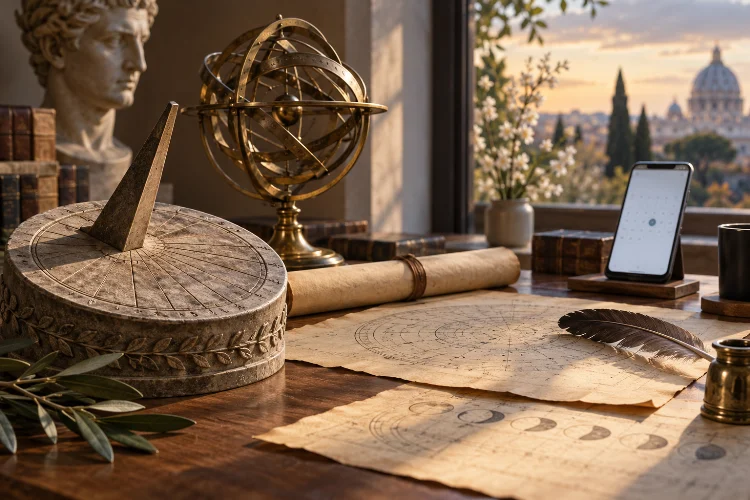
Most of us check the date without thinking twice. We know January comes before February, a normal year has 365 days, and every few years February gets an extra day. It all feels completely natural.
But the calendar on your phone is actually the result of thousands of years of observation, politics, mathematics, religion, and repeated correction. It was not invented by one person in a single moment.
So, how was the modern calendar created? The short answer is that ancient civilizations first developed ways to organize days, months, and seasons.
The Romans later built their own calendar, Julius Caesar introduced a major reform, and more than 1,600 years later Pope Gregory XIII approved another correction.
That final reform produced the Gregorian calendar, which eventually became the dominant civil calendar used around the world today.
Its history also explains some strange things we still live with, including February’s unusual length and the complicated rules surrounding leap years.
Early Calendars Started With the Sky
Long before printed calendars existed, people needed reliable ways to know when seasons would change, crops should be planted, religious festivals should happen, and taxes or debts were due.
The easiest clock available was the sky.
Ancient societies watched the daily movement of the Sun, the phases of the Moon, and seasonal changes. This created three basic units that still shape calendars today: the day, month, and year.
The problem was that these cycles do not fit together perfectly. A year is not made up of an exact number of days, and a solar year does not contain an exact number of lunar months. That mismatch is one reason calendar-making became surprisingly complicated.
Different civilizations solved the problem in different ways. Some calendars focused mainly on lunar cycles, while others tried to follow the solar year and seasonal changes.
The Roman Calendar Had a Timing Problem
The calendar that most directly influenced today’s system came from ancient Rome.
Early Roman calendars went through several changes. Months could be adjusted, extra days could be inserted, and political officials sometimes had influence over how the calendar was managed.
Over time, the system became increasingly difficult to keep aligned with the seasons.
That mattered because a calendar is only useful if dates roughly match the natural cycle they are supposed to represent. If spring slowly starts appearing on dates officially considered winter, something has clearly gone wrong.
By the first century BCE, Rome needed a more predictable system.
Julius Caesar eventually became the central figure in that reform.
Julius Caesar Created the Julian Calendar
In 46 BCE, Julius Caesar introduced what became known as the Julian calendar. It established a normal year of 365 days and added an extra day approximately every fourth year.
This produced an average calendar year of 365.25 days.
For its time, this was an impressive solution.
Instead of relying on irregular corrections, Rome now had a much more systematic method of keeping its civil year close to the solar cycle. The basic structure was so successful that many parts of it survived into the modern calendar.
The Julian system also helped establish the familiar pattern of months that eventually developed into the calendar we recognize today.
But there was one small problem.
A year is not exactly 365.25 days long.
That tiny difference would eventually become a very big deal.
Why the Julian Calendar Slowly Drifted
The tropical year—the seasonal cycle measured from one spring equinox to the next—is slightly shorter than 365.25 days.
According to the U.S. Naval Observatory, the Julian year exceeded the tropical year by roughly 0.0078 day. That sounds insignificant, but the error accumulated to a little more than three-quarters of a day every century.
After hundreds of years, the calendar and the seasons slowly moved apart.
This became especially important for the Christian Church becuase calculations related to Easter depended on the timing of the spring equinox. Church calculations treated March 21 as the equinox, but the actual astronomical event had gradually shifted away from that date.
By the sixteenth century, the difference was large enough that reform was difficult to ignore.
The solution was not to throw away the Julian system entirely. Instead, scholars refined it.
The Gregorian Calendar Reform of 1582
The reform associated with Pope Gregory XIII produced what we now call the Gregorian calendar.
The calendar was introduced in 1582. One of its major goals was to bring the date of the spring equinox back into alignment with the calendar system used for calculating Easter.
The intellectual work behind the reform involved several scholars. Italian physician and astronomer Aloysius Lilius, also known as Luigi Lilio, developed the proposal that became the foundation of the new system.
Jesuit mathematician and astronomer Christopher Clavius served on the commission that accepted the proposal and later became an important defender and explainer of the reformed calendar.
Pope Gregory XIII gave the reform official authority, which is why the calender carries his name rather than Lilius’.
A dramatic correction was also needed.
In places that adopted the reform immediately, Thursday, October 4, 1582, was followed by Friday, October 15. Ten calendar dates effectively disappeared so the calendar could reconnect with the seasonal cycle.
Nobody actually lost ten physical days. Only the numbering of the dates changed.
How the Modern Leap Year Rule Works
The cleverest part of the Gregorian reform was its improved leap-year system.
The Julian calendar simply added a leap day every four years. The Gregorian calendar made the rule slightly more selective.
The Rule We Still Use Today
A year divisible by four is normally a leap year.
However, years divisible by 100 are not leap years—unless they are also divisible by 400.
That means 2000 was a leap year, but 1900 was not. Likewise, 2100 will not contain February 29.
Over a 400-year cycle, the Gregorian system contains 97 leap years.
The result is an average year of 365.2425 days, which is much closer to the tropical year than the Julian average of 365.25 days.
The U.S. Naval Observatory estimates that it takes roughly 3,300 years for the Gregorian system to accumulate an error of about one day relative to the seasons.
That tiny mathematical adjustment is one of the main reasons the system has lasted so long.
The World Did Not Adopt It Overnight
Although the Gregorian calendar appeared in 1582, the whole world did not immediately switch.
Catholic countries including Italy, Spain, Portugal, and Poland were among the early adopters. Protestant and Orthodox regions were more cautious, partly because the reform had been issued under papal authority.
England and its colonies, for example, did not change until 1752. Their transition moved directly from September 2 to September 14.
Other countries changed much later.
This means historians have to be careful when reading old documents. The same historical moment could be recorded under different dates depending on which calendar a country was using at the time.
Eventually, however, international trade, diplomacy, transportation, science, and administration created strong practical reasons for goverments to share a common dating system.
The Gregorian calendar gradually became the dominant international civil standard.
Why Do We Still Have 12 Unequal Months?
One thing the Gregorian reform did not do was redesign everything from scratch.
It retained the existing month structure inherited from the Julian tradition. That is why some months contain 30 days, others 31, and February normally has only 28.
From a modern design perspective, it may look unnecessarily messy. Someone creating a brand-new calendar today might prefer months of equal length.
But calendars are not just mathematical systems.
They are also cultural systems.
Changing month lengths would affect religious observances, contracts, birthdays, anniversaries, government records, and countless traditions. Keeping familiar structures made calendar reform more practical than replacing them entirely.
That is an important part of the answer to how the modern calendar developed: successful reforms usually preserved what already worked and changed only what was necessary.
Why the Gregorian Calendar Became the Global Standard
Today, the Gregorian calendar is the internationally dominant civil calendar and is used across most of the world. Other calendar systems, including Islamic, Hebrew, Chinese, and various regional calendars, continue to be used for religious and cultural purposes.
The Gregorian system became especially useful as global communication expanded.
Shipping schedules, international contracts, scientific research, aviation, banking, computers, and global business all benefit from having dates that can be interpreted consistently.
Modern technical standards also build on it. ISO 8601, for example, uses the Gregorian calendar as the basis for standardized date representation.
So when your smartphone automatically shows a date, you are using a system connected to Roman administration, Renaissance astronomy, religious calculations, and centuries of international standardization.
All of those developments happened seperately across history, yet eventually became part of the same system.
The modern calendar was not invented in one brilliant afternoon. It developed through centuries of experimentation, correction, and compromise.
Ancient people began by observing natural cycles. The Romans created increasingly organized systems, Julius Caesar introduced the Julian calendar, and the Gregorian reform of 1582 corrected the small mathematical error that had accumulated over centuries.
The result is a calendar accurate enough to remain closely aligned with the seasons for thousands of years.
More importantly, its history shows how something as ordinary as checking today’s date can hide an extraordinary combination of astronomy, mathematics, religion, politics, and culture.
Next time you see February 29 or wonder why some months have 31 days, remember: those quirks are pieces of history still sitting inside your calendar.