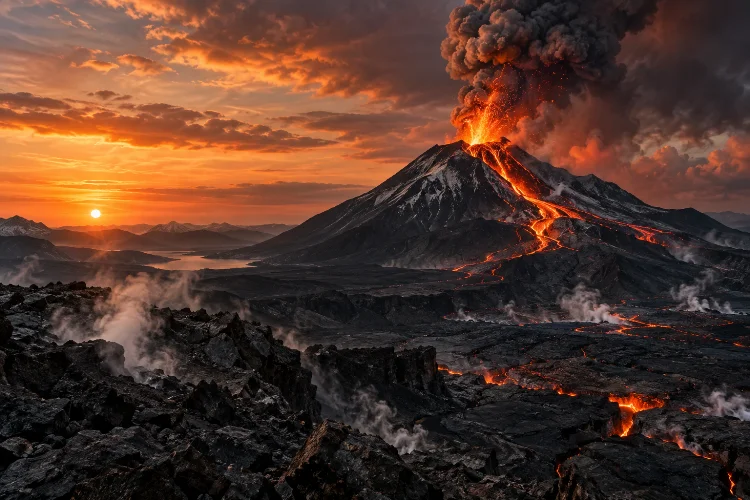
A volcano can look like an ordinary mountain for decades or even centuries. Then suddenly, gases escape, the ground shakes, ash rises into the atmosphere, and molten rock begins flowing across the landscape.
So, how are volcanoes formed?
The answer starts far beneath Earth’s surface. Our planet’s outer shell is divided into enormous tectonic plates that slowly move over hotter material below.
In certain places, changes in pressure, temperature, and water content allow solid rock to partially melt and create magma. That magma can rise through the crust and eventually reach the surface.
But not every volcano forms in exactly the same way.
Some develop where tectonic plates collide. Others appear where plates move apart, while volcanic island chains such as Hawaii can form above hotspots located far from plate boundaries. Repeated eruptions then gradually build layers of lava, ash, and other volcanic material.
Understanding this process helps explain not only where volcanoes appear, but also why some produce gentle lava flows while others erupt explosively.
Volcano Formation Begins Beneath Earth’s Surface
One common misconception is that a huge ocean of liquid magma sits directly beneath Earth’s crust.
In reality, most of Earth’s mantle is solid.
Magma forms only under particular geological conditions. The National Park Service explains that melting commonly occurs when hot mantle rises and experiences lower pressure, or when water and other fluids enter hot rock and lower its melting temperature.
Once rock partially melts, the resulting magma is generally less dense than the surrounding solid material.
That difference helps magma move upward through cracks and weak areas in the crust.
Magma vs. Lava
The terminology is simple but important.
Molten rock below Earth’s surface is called magma. Once that material erupts onto the surface, it is called lava.
Magma also contains crystals and dissolved gases. Those gases become extremely important when an eruption begins.
Tectonic Plates Create Many of the World’s Volcanoes
Earth’s outer shell, or lithosphere, is divided into large tectonic plates that move slowly relative to one another.
Most volcanic activity is strongly connected with these moving plates.
There are three major types of plate boundaries: divergent, convergent, and transform boundaries. Divergent and convergent boundaries are particularly important for volcanism, while transform boundaries generally produce earthquakes with much less volcanic activity.
This explains why volcanoes are not distributed randomly across Earth.
If you look at a global map, many volcanoes occur in recognizable belts along plate boundaries.
The Pacific region is the most famous example. The so-called Ring of Fire contains numerous volcanic regions associated largely with subduction around the Pacific Ocean. The Smithsonian Global Volcanism Program currently identifies hundreds of Holocene volcanoes within these regions.
Countries such as Indonesia, Japan, the Philippines, and Chile therefore experience frequent volcanic activity partly because of their tectonic settings.
Subduction Zones Can Create Explosive Volcanoes
Some of the world’s best-known volcanoes form where two tectonic plates move toward one another.
This is called a convergent plate boundary.
When a dense oceanic plate meets another plate, it may sink underneath it in a process known as subduction. As that descending plate moves deeper, heat and pressure cause minerals to release water and other fluids.
Those fluids rise into the hot mantle above and lower the temperature required for the rock to melt. Partial melting creates magma that can then travel upward through the crust.
Over time, repeated eruptions may create chains of volcanoes known as volcanic arcs.
Many subduction-zone volcanoes produce magma with relatively high silica content. This magma can be thick and sticky, making it harder for volcanic gases to escape.
Pressure can therefore build until an explosive eruption occurs.
Mount St. Helens in the United States and many volcanoes around Indonesia and Japan are associated with subduction environments.
Volcanoes Also Form Where Plates Move Apart
Volcanoes do not only appear where plates collide.
They can also form where plates separate.
At a divergent plate boundary, Earth’s crust stretches and becomes thinner. Hot mantle material rises beneath the opening.
As that material moves upward, the pressure decreases. This process, called decompression melting, allows some mantle rock to melt even without a major increase in tempertaure.
The magma can then rise through fractures and erupt.
A huge amount of this volcanic activity occurs beneath the oceans along mid-ocean ridges, where tectonic plates move apart and new oceanic crust forms.
Continental rifts can produce volcanism through a similar process.
The East African Rift is a well-known example of a region where Earth’s continental crust is stretching and breaking apart.
These geological settings show that volcano formation is closely connected to the movement and recycling of Earth’s crust.
Hotspots Can Build Volcanoes Far From Plate Boundaries
Not every volcano sits conveniently along the edge of a tectonic plate.
Some appear in the middle of plates.
These volcanoes are commonly associated with hotspots – areas where unusually hot mantle material rises toward the surface. As the material rises and pressure drops, melting can generate magma.
One of the most famous examples is Hawaii.
The Pacific Plate slowly moves over a hotspot, allowing volcanoes to form one after another. As a volcano is carried away from the hotspot by plate movement, volcanic activity eventually decreases while a new volcano begins forming above the active region.
Over millions of years, this process can create a chain of islands and underwater mountains.
The Hawaiian Islands provide a clear example.
Rather than all forming simultaneously, the islands developed at different times as the Pacific Plate moved across the volcanic hotspot.
Hotspot volcanism demonstrates why plate boundaries explain most – but not all – of Earth’s volcanoes.
How Magma Actually Reaches the Surface
Creating magma does not automatically create a volcanic eruption.
The molten material still needs to travel upward.
Because magma can be less dense than the surrounding rock, buoyancy encourages it to rise. Magma may move through cracks, fractures, and conduits and sometimes collect temporarily in underground storage regions often described as magma chambers or reservoirs.
As magma approaches the surface, the pressure surrounding it decreases.
This is where gases become especially important.
Think about opening a bottle of soda. While the bottle is sealed, carbon dioxide remains dissolved in the liquid under pressure. When you open it, pressure drops and bubbles suddenly appear.
Something similar happens inside rising magma.
Dissolved water vapor, carbon dioxide, sulfur dioxide, and other gases can form bubbles as pressure decreases. Expanding gas may push magma farther upward and contribute to an eruption.
If magma finally breaks through the crust, lava, ash, gas, and fragments of rock may escape through volcanic vents.
Why Some Volcanoes Explode While Others Produce Lava Flows
Not every eruption looks like a dramatic explosion from a disaster movie.
Some volcanoes mainly produce relatively fluid lava.
One major factor is magma viscosity, or how easily magma flows.
Low-silica magma is often relatively runny. Gases can escape more easily, allowing lava to flow from vents with less explosive pressure.
This type of activity is common at Hawaiian volcanoes.
Thicker, silica-rich magma behaves differently.
Gas can become trapped inside the sticky material. As additional gas accumulates and expands, presssure rises. Eventually, the magma may fragment violently, producing ash, tephra, and explosive eruption columns.
Explosive eruptions can also generate pyroclastic flows – fast-moving mixtures of hot gas, ash, and rock.
Water can create additional hazards. Volcanic debris mixed with rain, rivers, melted snow, or ice can produce dangerous mudflows known as lahars.
So while magma formation begins the volcanic process, magma chemistry and gas behavior strongly influence what an eruption eventually looks like.
Repeated Eruptions Build Different Types of Volcanoes
A volcanic mountain usually develops through repeated eruptions.
Each event can deposit lava, ash, cinders, volcanic blocks, and other material around a vent. Over hundreds, thousands, or even millions of years, those deposits build recognizable volcanic landforms.
1. Shield Volcanoes
Shield volcanoes form mainly from fluid basaltic lava that spreads across large areas.
Repeated flows create broad mountains with gentle slopes. Hawaiian volcanoes such as Mauna Loa are classic examples.
2. Composite Volcanoes
Composite volcanoes, also called stratovolcanoes, contain alternating layers of lava, ash, and other volcanic debris.
They often form steep, impressive mountains and are common around subduction zones. Mount Fuji, Mount Rainier, and Mount St. Helens belong to this general category.
3. Cinder Cones
Cinder cones are smaller and simpler.
Gas-rich eruptions throw fragments of lava into the air. Those pieces cool and fall around the vent, gradually creating a cone.
Parícutin in Mexico provides a fascinating real-world example. It began erupting in a farmer’s field in 1943 and developed into a substantial volcanic cone during about nine years of activity.
Lava domes form differently again, as extremely viscous lava slowly piles up around a vent.
These different shapes are essentially geological records of how magma behaved during past eruptions.
Volcanoes Are Constantly Reshaping the Planet
Volcanoes can be destructive, but they are also fundamental builders of Earth’s surface.
Lava creates new rock when it cools. Repeated underwater eruptions help produce oceanic crust, while hotspot volcanism can build entire islands.
Volcanic material can also eventually weather into fertile soil.
At the same time, eruptions may dramatically transform landscapes within hours. Lava can cover existing terrain, explosive eruptions can remove sections of mountains, and large eruptions can create depressions known as calderas.
Volcanoes therefore represent both destruction and creation.
The same geological processes capable of threatening communities are also responsible for building mountains, islands, and new sections of Earth’s crust.
That constant recycling is part of what makes our planet geologically active.
So, how are volcanoes formed? The process begins when geological conditions allow rock beneath Earth’s surface to partially melt into magma. That commonly happens at subduction zones, divergent plate boundaries, and hotspots.
Buoyant magma then moves upward through the crust. As pressure falls, dissolved gases expand and can eventually help drive an eruption.
Repeated eruptions deposit lava, ash, and other volcanic materal, gradually building volcanoes ranging from broad shields to steep stratovolcanoes.
Their locations and eruption styles are not random. They reveal what is happening deep beneath Earth’s surface.
The next time you see a volcano on a map or in the news, look at the surrounding tectonic plates. Understanding that geological setting can tell you a surprising amount about why the volcano exists in the first place.