Most people know Leonardo da Vinci because of the Mona Lisa. Others remember him for The Last Supper, strange flying machines, anatomical drawings, or notebooks filled with inventions that looked centuries ahead of their time.
But Leonardo was difficult to place into a single category.
Born in 1452 during the Italian Renaissance, he worked as a painter, draftsman, engineer, anatomist, designer, mapmaker, and observer of nature.
His interests ranged from the structure of the human heart to the movement of water, the flight of birds, military equipment, optics, and architecture.
The Metropolitan Museum of Art describes drawing as one of the main tools Leonardo used to investigate both art and nature.
That is what makes Leonardo da Vinci: artist, scientist, and inventor such an interesting subject.
He did not separate creativity from observation. For Leonardo, studying a muscle could improve a painting, while watching a bird might inspire a machine.
More than 500 years later, that combination still makes his work feel surprisingly modern.
Leonardo Began as an Artist in Renaissance Florence
Leonardo was born near the Tuscan town of Vinci in 1452.
As a young man, he trained in Florence in the workshop of Andrea del Verrocchio, one of the city’s important artists.
Renaissance workshops were not limited to painting. Apprentices could learn drawing, sculpture, metalworking, engineering techniques, and other practical skills.
That environment suited Leonardo perfectly.
He became obsessed with understanding how things actually looked and worked. Rather than simply following artistic formulas, he studied light, shadow, movement, facial expressions, plants, animals, and human proportions.
Drawing became his visual language.
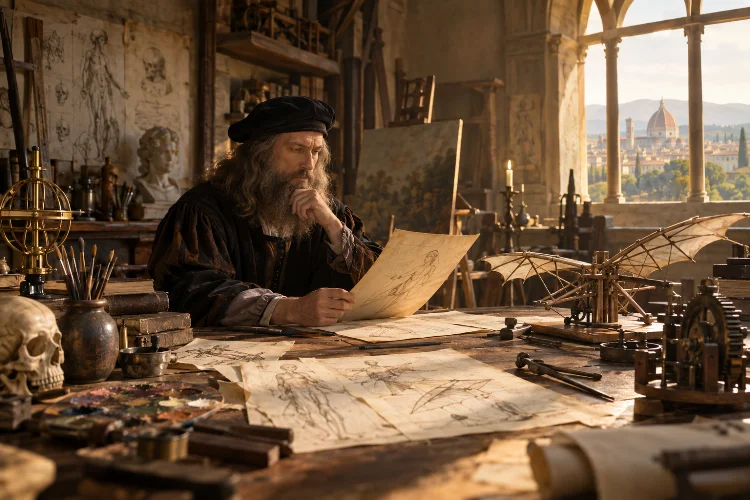
He could use one page to explore a mechanical device and another to study the folds of clothing or the structure of a hand. Sometimes artistic and scientific sketches even appeared together.
This habit eventually became one of the defining features of his career.
The Mona Lisa Shows Leonardo’s Artistic Genius
Leonardo produced relatively few completed paintings, but several became among the most famous artworks in history.
The most recognizable is the Mona Lisa, usually identified as a portrait of Lisa Gherardini, the wife of Florentine merchant Francesco del Giocondo.
Today, the painting is housed in the Louvre in Paris.
Its fame comes partly from the sitter’s mysterious expression, but Leonardo’s technique is equally important. The Louvre highlights his use of sfumato, a method of blending tones so gently that outlines seem to dissolve into soft transitions of light and shadow.
Instead of making facial features look sharply outlined, Leonardo created subtle changes around the eyes, mouth, and skin.
The result gives the portrait an almost lifelike quality.
His artistic success was closely connected to his scientific curiosity. Understanding light, perspective, anatomy, and visual perception helped him create paintings that felt more natural.
For Leonardo, art was not seperate from science. Each helped him understand the other.
The Last Supper Changed Renaissance Painting
Another masterpiece, The Last Supper, was painted in Milan between roughly 1494 and 1498.
The mural depicts the moment when Jesus tells his disciples that one of them will betray him. Instead of presenting the apostles as static figures, Leonardo turned the scene into an emotional explosion.
The disciples react with surprise, anger, fear, and confusion.
The official Museo del Cenacolo Vinciano notes that Leonardo was deeply interested in representing human emotion through facial expressions, gestures, and body movement.
He also used perspective to draw attention toward Christ at the center of the composition.
However, Leonardo experimented with an unusual painting method instead of using traditional wet fresco. His dry-wall technique gave him more time to work on details, but it was less durable.
The painting began deteriorating relatively soon after completion and has required extensive conservation.
It is a good example of Leonardo’s personality: extraordinary creativity sometimes came with risky experimentation.
Leonardo Studied the Human Body Like a Scientist
Leonardo’s anatomical drawings are among the clearest examples of his combination of art and science.
His interest began partly because artists needed to understand muscles, bones, and movement. But he soon went far beyond what was necessary for painting.
Leonardo studied the skeleton, brain, internal organs, muscles, reproductive system, blood vessels, and heart.
According to the Royal Collection Trust, he may have dissected around 30 human bodies during two major periods of anatomical research. He recorded his observations in hundreds of drawings and extensive notes.
His illustrations were remarkably sophisticated.
He showed structures from different angles, removed layers step by step, and sometimes used techniques similar to exploded diagrams used in modern technical illustration.
Leonardo even examined the human heart and analyzed it partly as a mechanical system.
Not every conclusion was correct. He remained influenced by some traditional medical theories and never fully discovered blood circulation.
Still, his observational method was extraordinary for his time.
Had his anatomical research been published widely during his lifetime, it might have had a much greater immediate impact on medicine.
His Notebooks Became a Laboratory on Paper
Leonardo left behind thousands of pages containing sketches, questions, diagrams, calculations, and observations.
The surviving sheets cover subjects including anatomy, plants, water, architecture, mathematics, geology, machines, weapons, and flight.
The Royal Collection alone holds more than 500 of his drawings.
Leonardo also famously wrote many private notes in mirror writing from right to left. Since he was left-handed, the style may simply have been comfortable for him rather than a secret code.
His notebooks reveal something important about how he thought.
Leonardo constantly asked questions.
How does water move around an obstacle? Why do birds remain in the air? How do muscles pull bones? How does light reach the eye?
He often preferred direct observation over simply accepting traditional explanations.
This emphasis on observation and experiement gave his work a distinctly scientific character, even though modern scientific methods had not yet fully developed.
Leonardo Designed Machines and Flying Devices
Leonardo’s reputation as an inventor comes mainly from designs preserved in his notebooks.
He sketched mechanisms involving gears, pulleys, lifting systems, weapons, bridges, water systems, and various forms of machinery.
Flight fascinated him especially.
After observing birds, he created designs for ornithopters, machines that attempted to imitate wing flapping. He also drew concepts related to parachutes and an aerial screw often compared with a primitive helicopter idea.
These drawings are visually impressive, but it is important not to exaggerate them.
Many of Leonardo’s machines were concepts rather than working inventions. There is little evidence that most were actually constructed or successfully tested during his lifetime.
Some would probably not have worked with the materials and power sources available at the time.
His importance therefore lies less in “inventing the helicopter hundreds of years early” and more in his habit of analyzing mechanical problems creatively.
He approached machines almost like anatomical bodies: as systems made from interacting parts.
He Was Also an Engineer and Mapmaker
Leonardo’s engineering work was not limited to imaginative machines.
He worked on practical projects involving water management, fortifications, architecture, and military technology.
During his time in Milan, he produced drawings connected with weapons and foundries. The Royal Collection includes studies showing artillery equipment and the organization of an arsenal.
Later, while working for the Florentine government, Leonardo studied the Arno River.
A surviving plan from 1504 shows a weir and damaged embankments, demonstrating how carefully he investigated water flow and landscape conditions.
His maps could be remarkably detailed because he combined artistic perspective with precise observation.
This ability made him useful not only as a painter but also as an enginering consultant.
His fascination with water continued throughout his life. He studied currents, waves, erosion, and swirling motion, often drawing patterns that look almost like modern fluid-dynamics diagrams.
Again, art and science overlapped.
Curiosity Was Leonardo’s Greatest Tool
Leonardo is often called a “Renaissance man,” meaning someone with knowledge and skills across many fields.
But his real strength was not simply knowing many things.
It was his curiosity.
He seemed unwilling to accept the surface appearance of almost anything. A smile became a study of facial muscles and emotion. A river became an investigation of currents. A bird became a question about aerodynamics.
Even an ordinary plant could become a detailed examination of growth and structure.
The Metropolitan Museum notes that his surviving drawings cover subjects ranging from botanical studies and anatomy to military engineering and mechanical designs.
This habit sometimes worked against him.
Leonardo frequently moved between projects and left several works unfinished. His perfectionism and constantly shifting interests could make completion difficult.
Yet those same tendencies produced an enormous body of ideas.
His notebooks show a mind constantly searching for connections between subjects that other people might consider completely unrelated.
Why Leonardo da Vinci Still Matters Today
Leonardo died in France in 1519, but his reputation continued to grow.
Today, he is remembered not only for individual paintings or inventions but for a particular approach to creativity.
He combined observation with imagination.
Modern fields often separate art, science, engineering, and design into different academic disciplines. Leonardo’s work reminds us that major ideas can emerge when those boundaries become less rigid.
Artists can learn from biology and physics. Engineers can benefit from visual thinking. Scientists can use drawing and design to communicate complex ideas.
Leonardo’s notebooks also offer another valuable lesson: curiosity does not always produce an immediate practical result.
Many of his ideas were unfinished, incorrect, or impossible to build.
But asking unusual questions pushed him toward discoveries and observations that were far ahead of conventional thinking in several areas.
His legacy is therefore not simply a collection of masterpieces.
It is a way of looking at the world.
Leonardo da Vinci was much more than the painter behind the Mona Lisa.
He was an artist who studied anatomy, a designer fascinated by machines, an engineer who investigated rivers and weapons, and an observer who filled thousands of pages with questions about nature.
Some of his inventions never became working machines, and some scientific conclusions were incorrect. What made him exceptional was his ability to connect creative imagination with careful observation.
That combination helped produce masterpieces such as The Last Supper, remarkable anatomical illustrations, and visionary mechnical designs.
More than five centuries later, Leonardo still offers a useful lesson: creativity becomes far more powerful when we remain curious about how the world actually works.
Take a look at one of his surviving notebook pages sometime – the mix of art, engineering, and unanswered questions reveals Leonardo more clearly than any single painting.