
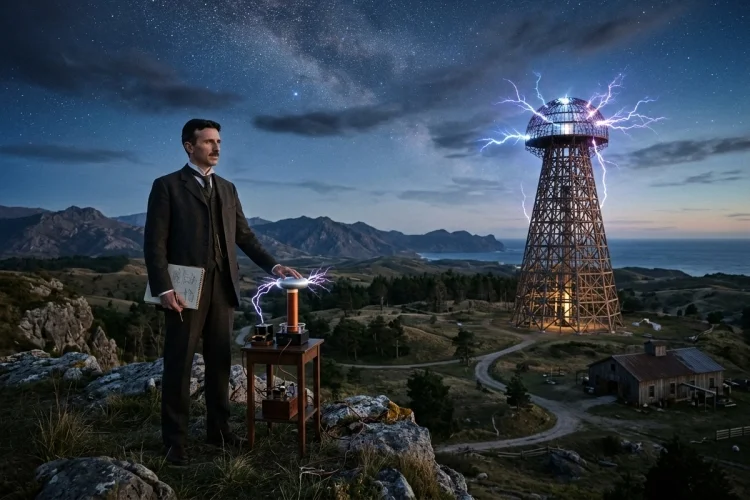
Nikola Tesla has become almost as famous for the inventions people imagine he created as for the technologies he actually developed. Online stories portray him as a forgotten genius who invented everything from free electricity to smartphones.
The real story is less magical – but far more interesting. Tesla was an electrical engineer and inventor whose experiments helped shape modern power systems.
His work on polyphase alternating current, induction motors, high-frequency electricity, wireless signals, and remote-controlled machines pushed engineering into unfamiliar territory. Some of his inventions became practical during his lifetime.
Others failed because the required technology, funding, or scientific understanding was not yet available. A few remained ambitious predictions rather than finished devices.
Examining Nikola Tesla and the ideas that were ahead of his time reveals both the power and limitations of visionary thinking.
Tesla could imagine future possibilities with remarkable clarity, but even brilliant ideas needed reliable engineering, business support, and practical applications before they could change the world.
From Smiljan to the American Electrical Industry
Nikola Tesla was born on July 10, 1856, in Smiljan, then part of the Austrian Empire and now located in Croatia. He studied engineering in Europe and became fascinated by electricity, motors, and the challenge of creating more efficient power systems.
Tesla moved to the United States in 1884 and briefly worked at Thomas Edison’s company in New York. Edison’s electrical business was strongly associated with direct current, while Tesla believed alternating current offered better possibilities for large-scale power distribution.
Their relationship has often been turned into a simple hero-versus-villain story. In reality, the development of electric power involved many engineers, investors, businesses, and competing patent systems—not just two inventors arguing in a laboratory.
Tesla eventually established his own laboratory and began developing motors and electrical equipment based on his ideas about rotating magnetic fields.
The Polyphase AC System Changed Modern Electricity
Alternating current, or AC, periodically reverses direction. Direct current, or DC, flows mainly in one direction.
Tesla did not invent alternating current itself. However, he made crucial contributions to a practical polyphase AC system, especially through his induction motor and rotating magnetic field designs.
An induction motor uses changing magnetic fields to make a rotor turn without requiring the same type of mechanical electrical contacts used in many earlier motors.
This made the design durable, efficient, and valuable for industrial machinery. The Smithsonian describes Tesla’s motor as a revolutionary device based on electromagnetic induction and rotating magnetic fields.
George Westinghouse recognized the commercial potential of Tesla’s work and obtained rights to his polyphase AC patents in 1888. Their partnership helped turn Tesla’s laboratory ideas into equipment that could be manufactured and installed on a much larger scale.
Modern factories, pumps, fans, household appliances, and electric vehicles still use induction-motor principles. That makes Tesla’s work more than a historical curiosity – it remains part of everyday technology.
The War of the Currents Proved AC Could Scale
During the late nineteenth century, supporters of AC and DC competed over which system should power growing cities. Edison promoted direct current, while Westinghouse backed alternating current using technology that included Tesla’s patents.
One major advantage of AC was that its voltage could be changed efficiently using transformers. Electricity could be transmitted at high voltage over long distances and then reduced to safer levels near homes and businesses.
Westinghouse’s AC system helped power the 1893 World’s Columbian Exposition in Chicago. The illuminated fair demonstrated publicly that alternating current could support a large and impressive electrical installation.
The Niagara Falls power project was an even more important milestone. Westinghouse received the contract to build generators using AC technology, and electricity from Niagara was eventually transmitted to Buffalo and nearby communities.
This project showed that electricity could be generated far from the people and industries using it. That basic model remains central to modern electrical grids.
The Tesla Coil Opened New Possibilities
Tesla invented the Tesla coil in 1891 while experimenting with high-frequency and high-voltage electricity. The device uses resonant electrical circuits to produce extremely high voltages, often creating dramatic sparks and glowing lamps.
Tesla used these experiments to study electrical resonance, wireless effects, lighting, and the behavior of rapidly changing currents. His public demonstrations looked almost theatrical, helping him gain a reputation as both a serious inventor and an electrical showman.
Tesla coils later became useful in early radio research and laboratory demonstrations. Modern versions are still used for educational displays, entertainment, and specialized scientific purposes.
Smithsonian archival material connects Tesla’s high-frequency research with developments in fluorescent and neon-style lighting as well as wireless experimentation.
The Tesla coil did not directly become a household power source. Its importance lies in how it helped scientists and engineers explore resonance, radio-frequency electricity, insulation, and wireless transmission.
Wireless Communication and the Wardenclyffe Dream
Tesla believed information – and possibly electrical power – could be transmitted without conventional wires. Today, wireless communication is normal, but during the 1890s, sending signals invisibly across long distances seemed almost unbelievable.
After conducting large-scale experiments in Colorado Springs, Tesla began building Wardenclyffe on Long Island.
The site included a laboratory and a huge transmitting tower intended to support a worldwide wireless communication system. Tesla also discussed transmitting energy through the Earth and atmosphere.
The project received financial support from banker J. P. Morgan, but its purpose became increasingly ambitious and expensive. Funding stopped, construction remained incomplete, and the tower never became an operating global network.
Wardenclyffe is often described online as a finished system for providing unlimited free electricity. That claim goes far beyond the evidence.
Tesla had bold theories and performed real wireless experiments, but he did not demonstrate a practical worldwide method for delivering large amounts of useful power freely to everyone.
Still, his broader belief that the world would become connected through wireless signals was remarkably forward-looking.
Remote Control Anticipated Robotics and Drones
One of Tesla’s most impressive demonstrations took place in 1898, when he presented a radio-controlled boat at Madison Square Garden. Spectators watched as he remotely controlled the vessel’s steering and movement.
Tesla’s patent described a method for controlling the engines, steering system, and other mechanisms of a moving vessel from a distant location. This was not simply a toy – it demonstrated that wireless commands could control a machine without a person physically operating it.
Tesla called this field “telautomatics.” He imagined machines capable of following transmitted instructions and eventually performing increasingly complex tasks.
The demonstration anticipated principles now found in remote-controlled vehicles, guided systems, industrial automation, robotics, and drones.
Tesla did not build a modern autonomous robot, but he understood that machines could be controlled through coded signals long before electronic computing made advanced automation practical.
Why Some Tesla Ideas Failed
Tesla was brilliant at visualizing electrical systems, but invention requires more than imagination. A successful technology must also be reliable, affordable, manufacturable, safe, and useful enough to attract customers or investors.
His AC motor solved a clear industrial problem and succeeded through Westinghouse’s manufacturing resources. Wardenclyffe, by contrast, required enormous investment while its business model and technical goals remained uncertain.
Tesla also became increasingly willing to announce dramatic ideas before producing convincing evidence. Later claims about advanced energy systems, powerful weapons, and unusual communication methods contributed to his legendary image but were not always supported by working technology.
Separating fact from myth does not diminish Tesla. It makes his authentic accomplishments easier to appreciate.
He was neither an ignored magician whose finished inventions were secretly suppressed nor the sole creator of the electrical age. He was a gifted engineer working within a larger international community of inventors and scientists.
Tesla’s Lasting Scientific and Cultural Legacy
Tesla died in New York in 1943, but his strongest inventions continued to influence electrical engineering. His polyphase system and induction motor helped make large-scale electrification practical, while his experiments contributed to research involving radio-frequency currents, wireless control, and automation.
His name was later given to the tesla, the scientific unit used to measure magnetic flux density. It is a fitting tribute to someone whose most important work depended heavily on rotating magnetic fields.
Tesla’s cultural legacy is equally powerful. He represents the independent inventor who thinks beyond accepted limits, takes enormous risks, and imagines technologies society is not yet ready to build.
His life also offers a practical lesson: creativity and technical talent are essential, but they work best when combined with evidence, collaboration, financial planning, and realistic engineering.
Nikola Tesla produced several ideas that genuinely were ahead of his time. His induction motor and polyphase AC technology helped create the modern electrical grid, while his experiments with high-frequency currents expanded the possibilities of electrical engineering.
His radio-controlled boat anticipated remote systems, robotics, and drones. Wardenclyffe failed, but Tesla’s vision of worldwide wireless communication pointed toward a future filled with connected devices and instant information.
Not every popular claim about him is accurate, and not every experiment became a practical invention. That does not weaken his legacy.
It reveals something more valuable: innovation grows through both success and failure. Explore Tesla’s original patents, museum collections, and laboratory history to discover the real inventor behind the modern myths.