Imagine discovering that ordinary-looking rocks are quietly releasing invisible energy. At the end of the nineteenth century, that idea sounded almost impossible because scientists still had a very incomplete picture of what existed inside an atom.
Then a series of experiments changed physics forever.
The story of Marie Curie and the discovery of radioactivity is often simplified into the idea that Curie discovered radioactivity by herself. The real history is more interesting.
French physicist Henri Becquerel first observed spontaneous radiation from uranium in 1896. Marie Curie then turned that mysterious phenomenon into a major field of scientific research.
Working first independently and later with her husband, Pierre Curie, she investigated radioactive materials, coined the term “radioactivity,” and helped discover two new elements: polonium and radium.
Her work challenged established ideas about atoms and eventually influenced physics, chemistry, medicine, and nuclear science.
It was groundbreaking science performed with surprisingly simple equipment – and with dangers that researchers did not yet fully understand.
Radioactivity Started With Henri Becquerel
Before Marie Curie’s famous experiments, another discovery had already opened the door.
In 1895, Wilhelm Conrad Röntgen discovered X-rays. Scientists across Europe immediately became interested in mysterious forms of radiation and began experimenting with substances that might produce similar effects.
Henri Becquerel was studying uranium salts when he discovered something unexpected in 1896. Uranium could expose photographic plates even without being stimulated by sunlight. The radiation seemed to come naturally from the material itself.
Becquerel had discovered natural radioactivity, although the phenomenon was not yet understood in modern terms.
Marie Curie’s achievement was not simply repeating his experiment. She asked a much bigger question: What exactly was causing this radiation, and were other materials doing the same thing?
That question would transform her career.
Marie Curie Turned a Mystery Into a Research Field
Marie Skłodowska Curie was born in Warsaw in 1867 and later moved to Paris to continue her education. She studied physics and mathematics at the Sorbonne, where she eventually met physicist Pierre Curie.
When Marie began searching for a doctoral research topic, Becquerel’s uranium rays caught her attention.
Instead of relying mainly on photographic plates, she measured electrical effects produced when radiation ionized the surrounding air. Her research showed that the intensity of radiation depended on the amount of radioactive material present.
This led her toward an important idea.
The radiation did not appear to depend on the chemical arrangement of a substance. Something seemed to be happening inside the atom itself.
At a time when atoms were commonly treated as essentially indivisible building blocks, this was a radical concept. Curie’s research helped reveal that atoms were much more complex than scientists had previously believed.
She also introduced the word radioactivity to describe this remarkable property.
Pitchblende Revealed an Unexpected Clue
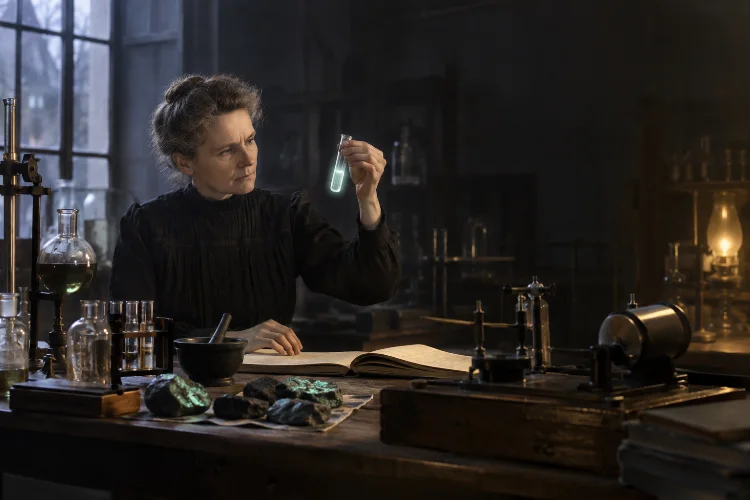
One of Curie’s most important observations came while studying a uranium-rich mineral called pitchblende.
If uranium was responsible for the radiation, then pitchblende should have produced an amount of radiation roughly consistent with its uranium content.
But it didn’t.
Some samples were considerably more radioactive than pure uranium.
Marie realized this could mean the ore contained other, unknown substances that were even more radioactive. Pierre Curie became increasingly interested in her work and joined the investigation.
This was a clever example of using measurements to predict something researchers could not yet directly see.
Instead of finding a mysterious experimental error, the Curies suspected they had found evidence of unknown chemical elements.
Now they had to prove it.
That required an enormous amount of physical and chemical work using relatively basic laboratory equipement.
The Discovery of Polonium and Radium
In 1898, Marie and Pierre Curie announced evidence for a previously unknown element.
Marie named it polonium, after Poland, the country of her birth.
Later that same year, the Curies announced another highly radioactive element: radium. Both had been detected while processing pitchblende and studying the radioactivity of its components.
Discovering evidence of these elements was one thing. Isolating them was much harder.
The Curies processed enormous quantities of uranium ore through repeated chemical separation and crystallization. According to the Science History Institute, their work eventually produced tiny quantities of highly radioactive radium compounds from tons of ore.
The conditions were far from what we would imagine for an important modern research laboratory.
Marie worked for years processing heavy containers of material, heating solutions, separating chemicals, and repeatedly measuring their radioactivity.
The process was slow, physically demanding, and potentially dangerous.
At the time, however, the biological risks of radiation exposure were still poorly understood.
Why Radium Changed Our Understanding of the Atom
Radium was fascinating because its behavior seemed to break familiar rules.
It continuously produced radiation and could release measurable energy without being heated or powered by any obvious external source. Researchers gradually realized that radioactive atoms could transform over time.
This helped destroy the older image of atoms as permanently stable and indivisible pieces of matter.
Marie Curie later explained that radioactive substances represented a new property of matter. The rapid research that followed created what she described in her 1911 Nobel lecture as essentially a new scientific field.
Other researchers, including Ernest Rutherford, went on to study different forms of radiation and atomic structure.
The results eventually helped scientists understand atomic nuclei, radioactive decay, isotopes, and nuclear transformations.
Modern nuclear physics did not come from one experiment or one researcher. But Curie’s work became one of its most important foundations.
Marie Curie Won Two Nobel Prizes
The scientific world soon recognized the importance of the research.
In 1903, Henri Becquerel received half of the Nobel Prize in Physics for discovering spontaneous radioactivity. Marie and Pierre Curie shared the other half for their research into the radiation phenomena Becquerel had discovered.
Marie became the first woman to receive a Nobel Prize.
Her career did not stop there.
After Pierre died in an accident in 1906, Marie continued their research and became the first woman professor at the Sorbonne.
In 1911, she received the Nobel Prize in Chemistry for work involving radium and polonium, including the isolation and study of radium.
She became the first person to receive two Nobel Prizes and remains the only individual awarded Nobel Prizes in two different scientifc categories.
Her success was especially remarkable in an era when women faced major barriers to entering professional science.
Radioactivity Soon Entered Medicine
The discovery of radioactive materials quickly created interest beyond physics and chemistry.
Scientists and doctors began investigating how radiation interacted with living tissue. Those experiments eventually contributed to the development of radiation-based treatments for diseases including cancer.
Curie herself strongly supported medical applications of radiation.
During World War I, she helped organize mobile X-ray units that could travel near battlefields. These vehicles allowed doctors to locate bullets, fractures, and other internal injuries without immediately relying on exploratory surgery.
The vehicles became popularly associated with Curie and were sometimes called “Little Curies.”
This work showed how discoveries in fundamental physics could quickly produce practical medical applications.
Modern radiology and radiation therapy are far more advanced and carefully controlled, but they belong to a technological story that began during this early era of radiation research.
The Hidden Danger of Radiation Exposure
Early researchers were fascinated by radioactive materials partly because nobody fully understood their risks.
Radium could create visible effects and generate heat. Radioactive products were eventually promoted in various consumer products during the early twentieth century, sometimes with wildly exaggerated health claims.
Today, scientists understand that ionizing radiation can damage cells and DNA.
Marie Curie spent decades handling radioactive substances without the protective procedures that modern laboratories consider essential.
Her notebooks and other laboratory materials were exposed to radioactive contamination, reflecting how little researchers initially knew about long-term exposure.
Curie died in 1934 after developing aplastic anemia, an illness associated with prolonged radiation exposure. Her research environment almost certainly involved radiation doses that would be considered extremely unsafe today.
It is a sobering part of her legacy: the scientists uncovering the power of radiation were simultaneously discovering its risks, often through thier own exposure.
How Curie’s Discoveries Still Affect Modern Science
The impact of Marie Curie’s research extends far beyond radium.
Radioactive isotopes are now used in medical diagnosis, cancer treatment, scientific research, industrial testing, archaeology, energy production, and many other fields.
Nuclear medicine, for example, uses carefully selected radioactive substances to help doctors observe processes occurring inside the human body.
Research into radioactive decay also helped scientists develop methods for dating ancient materials and understanding the age of Earth.
Later generations built directly on the work started by Becquerel and the Curies. Marie’s daughter Irène Joliot-Curie and her husband Frédéric Joliot-Curie discovered artificial radioactivity and received the 1935 Nobel Prize in Chemistry for their work.
Science had moved from discovering naturally radioactive materials to deliberately creating radioactive isotopes.
That transformation shows how quickly the field developed.
Within only a few decades, a strange photographic plate in Becquerel’s laboratory had opened an entirely new understanding of matter.
Marie Curie did not discover radioactivity alone. Henri Becquerel first observed spontaneous uranium radiation in 1896, but Curie transformed that observation into a systematic scientific field.
Her measurements revealed important properties of radioactive materials, while her collaboration with Pierre Curie led to the discovery of polonium and radium.
Those findings challenged traditional ideas about atoms and helped prepare the way for modern nuclear physics, radiology, and radiation medicine.
Her two Nobel Prizes also made her one of the most significant scientists in modern history.
The next time you hear about X-rays, radiation therapy, nuclear medicine, or radioactive isotopes, remeber how much of that scientific journey traces back to experiments conducted more than a century ago.