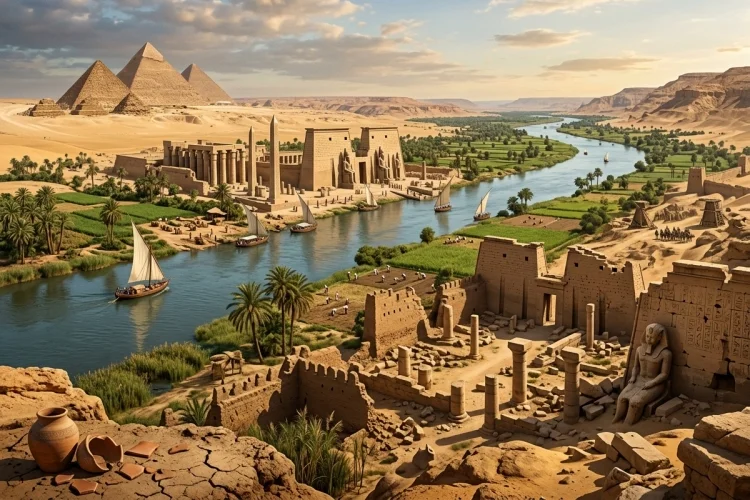
Ancient Egypt was not built in a day – or even a century. It developed over thousands of years beside the Nile River, growing from small farming communities into one of the ancient world’s most powerful and recognizable civilizations.
The history of Ancient Egypt includes giant pyramids, ambitious pharaohs, religious revolutions, military victories, civil wars, foreign invasions, and long periods of recovery.
Its rulers controlled valuable trade routes, built enormous temples, developed sophisticated writing systems, and created beliefs about death that still fascinate people today.
However, Egypt’s history was not one continuous golden age. Strong kingdoms were repeatedly followed by political division, economic trouble, and outside rule. Even the famous Cleopatra VII governed during a period when Egypt’s independence was under serious pressure.
To understand how this civilization lasted for more than three millennia, we need to begin with the natural force that made almost everything possible: the Nile.
How the Nile Made Egyptian Civilization Possible
Most of Egypt is desert, yet the Nile River created a long strip of fertile land where communities could grow crops and raise animals. Its seasonal flooding deposited rich soil along the riverbanks, helping farmers produce wheat, barley, flax, vegetables, and other essential goods.
The Nile also acted like an ancient highway. Boats transported people, stone, grain, soldiers, and trade goods between settlements, connecting Upper Egypt in the south with Lower Egypt in the north.
Because agricultural production could support large populations, some villages gradually became towns and political centers. Leaders gained influence by controlling land, irrigation, labor, storage facilities, and trade networks.
Egypt’s geography offered protection as well. Deserts to the east and west, Mediterranean waters to the north, and difficult river regions to the south made large-scale invasions more challenging, although never impossible.
The Unification of Upper and Lower Egypt
Before Egypt became a unified kingdom, separate communities and regional powers competed along the Nile. By approximately 3100 BCE, Upper and Lower Egypt were brought together under one ruler, beginning the Early Dynastic Period.
Tradition often credits a king called Menes with the unification, while archaeological evidence is commonly associated with rulers such as Narmer.
Historians still debate whether Menes and Narmer were the same person or whether unification was a longer process involving several kings. The new state developed a centralized monarchy supported by officials, priests, scribes, craftspeople, farmers, and soldiers.
The ruler, later known as the pharaoh, was not viewed simply as a political leader. He was closely connected to divine order and was expected to maintain stability, justice, and harmony.
Hieroglyphic writing also emerged during this early era. It allowed officials to record royal names, religious ideas, taxes, offerings, property, and major events, strengthening the government’s ability to manage a growing kingdom.
The Old Kingdom and the Age of the Pyramids
The Old Kingdom, beginning around the third millennium BCE, is best known as the great age of pyramid construction. During this period, the monarchy became highly organized and could command enormous amounts of labor and resources.
King Djoser’s Step Pyramid at Saqqara was an important architectural breakthrough. Later, the pharaohs Khufu, Khafre, and Menkaure built the famous pyramid complexes at Giza.
The Great Pyramid of Khufu was constructed from millions of stone blocks and remained the tallest human-made structure in the world for thousands of years.
These monuments were not isolated tombs but parts of larger complexes that included temples, causeways, smaller pyramids, and burial grounds.
Contrary to the popular image of huge armies of enslaved people, archaeological evidence suggests that much of the workforce included organized laborers, skilled specialists, and seasonal workers. Farmers may have participated when the Nile’s flood limited agricultural work.
The pyramids demonstrated royal authority, religious belief, engineering knowledge, and the government’s ability to organize supplies on an extraordinary scale.
However, royal power eventually weakened as local officials became more independent and the central administration struggled to maintain control.
The Middle Kingdom: Recovery and Renewal
The end of the Old Kingdom led to the First Intermediate Period, an era of political division in which regional leaders competed for power. Egypt was eventually reunited around 2030 BCE by Mentuhotep II, beginning the Middle Kingdom.
Middle Kingdom rulers strengthened the central government, expanded agricultural projects, reorganized administration, and increased Egypt’s influence beyond its traditional borders. Trade connections brought valuable materials such as gold, timber, incense, ivory, and exotic goods into the country.
This era was also a major period of literature and artistic development. Egyptian texts explored leadership, morality, loyalty, personal hardship, and uncertainty in ways that often feel surprisingly human to modern readers.
Royal art changed as well. Some statues showed rulers with tired eyes, serious expressions, and less idealized faces, perhaps presenting kingship as a difficult responsibility rather than effortless perfection.
The Middle Kingdom eventually weakened as rulers lost control over parts of the country. New groups entered the Nile Delta, setting the stage for another period of division.
The New Kingdom: Egypt at the Height of Its Power
During the Second Intermediate Period, a group known as the Hyksos controlled much of northern Egypt. Egyptian rulers based in the south fought back, and Ahmose I eventually expelled the Hyksos and reunited the country around 1550 BCE.
His victory began the New Kingdom, one of the most powerful periods in Egyptian history. Unlike many earlier rulers, New Kingdom pharaohs launched major military campaigns and created an empire extending into Nubia and parts of the eastern Mediterranean region.
Famous rulers of this era included Hatshepsut, Thutmose III, Amenhotep III, Akhenaten, Tutankhamun, Seti I, and Ramesses II. Hatshepsut promoted trade and monumental construction, while Thutmose III led successful campaigns that expanded Egyptian influence.
Akhenaten later introduced a dramatic religious change centered on the Aten, the visible sun disk. He moved the royal court to a new capital and reduced the influence of traditional gods, but his reforms were largely reversed after his death.
Tutankhamun became far more famous in modern times than he was during his short reign because his nearly intact tomb was discovered in 1922. Ramesses II, meanwhile, ruled for decades, built extensively, and fought the Hittites at the Battle of Kadesh.
The New Kingdom produced enormous temple complexes, richly decorated royal tombs, international diplomacy, and impressive wealth. Yet maintaining an empire was expensive, and political pressures gradually grew.
Decline, Division, and Foreign Rule
After the New Kingdom, Egypt entered the Third Intermediate Period. Central authority weakened, and different regions were controlled by competing rulers, powerful priests, and foreign dynasties.
Egypt did not suddenly collapse. Instead, it experienced repeated cycles of reunification, fragmentation, and recovery. Libyan dynasties ruled parts of the country, while Kushite kings from Nubia later gained control and presented themselves as restorers of traditional Egyptian culture.
The Assyrian Empire invaded Egypt during the seventh century BCE. Egyptian rulers later regained some independence, but the country remained vulnerable to larger imperial powers.
The Persian Achaemenid Empire conquered Egypt in 525 BCE. Although Egyptian dynasties temporarily returned, Persia regained control in 343 BCE.
These foreign rulers often adopted Egyptian royal titles and participated in local religious traditions. This helped them claim legitimacy, but resistance continued because many Egyptians viewed outside governments as politically and economically oppressive.
Cleopatra, Rome, and the End of Pharaonic Independence
Alexander the Great conquered Egypt in 332 BCE while fighting the Persian Empire. After his death, one of his generals, Ptolemy, took control and founded the Ptolemaic dynasty.
The Ptolemies were Macedonian Greek rulers, but they presented themselves as pharaohs and supported many Egyptian temples. Their capital, Alexandria, became an important center of Mediterranean commerce, scholarship, and culture.
Over time, however, the dynasty suffered from family conflicts, rebellions, financial problems, and growing dependence on Rome. Cleopatra VII, the final active Ptolemaic ruler, attempted to protect Egypt’s position through political and personal alliances with Julius Caesar and later Mark Antony.
After Antony and Cleopatra were defeated by Octavian’s forces, both died in 30 BCE. Egypt was then annexed by Rome, and Augustus ended the independent Ptolemaic monarchy.
This event is often described as the fall of Ancient Egypt, but Egyptian culture did not immediately disappear. Temples remained active, traditional beliefs continued, and Egyptian artistic ideas influenced the Roman world. What ended was Egypt’s status as an independently ruled pharaonic kingdom.
The history of Ancient Egypt stretched from early Nile communities and political unification to pyramids, imperial expansion, foreign conquest, and Roman annexation.
Its greatest strength was its ability to recover after periods of disorder, adapt to new rulers, and preserve a recognizable cultural identity across thousands of years.
The civilization’s political independence ended in 30 BCE, but its legacy survived through architecture, writing, religion, art, engineering, and historical memory.
The pyramids and temples are impressive, yet the full story is even more interesting because it reveals the ambitions, struggles, and everyday lives behind the monuments.
Explore museum collections, translated Egyptian texts, and archaeological discoveries to continue uncovering one of history’s most enduring civilizations.