Rome began as one settlement among many on the Italian Peninsula. It had no guaranteed path to greatness, no unbeatable army, and certainly no ready-made empire.
Yet over several centuries, it grew into the dominant power of the Mediterranean world, controlling territories across Europe, North Africa, and western Asia.
So, how did the Roman Empire become a global power? In the ancient context, “global” does not mean Rome ruled the entire planet. It means the Romans created one of the largest, wealthiest, and most influential political systems known to the people of their time.
Military strength was essential, but conquest alone does not explain Rome’s success. Roman leaders formed alliances, absorbed defeated communities, built roads and ports, protected trade routes, collected taxes, and allowed local elites to participate in imperial government.
Later, Augustus transformed the territories won by the Roman Republic into a more stable imperial system. Rome’s rise was therefore not one dramatic victory. It was a long process of warfare, adaptation, organization, and integration.
Rome First Built Its Power in Italy
Before Rome could dominate the Mediterranean, it had to survive competition from neighboring Latin communities, Etruscan cities, Samnites, Greek settlements, and other Italian peoples.
Rome expanded through a mixture of warfare, treaties, colonies, and alliances. Defeated communities were not always treated in the same way. Some received Roman citizenship, others gained limited legal rights, and many became allies required to provide troops.
This flexible arrangement gave Rome access to a much larger pool of soldiers than a single city could supply. It also allowed conquered communities to keep some local customs and institutions, reducing the need for direct Roman control over every town.
The system was far from peaceful or equal. Allies often carried heavy military obligations without enjoying the political privileges of full Roman citizens. Still, Rome’s ability to incorporate outsiders rather than simply destroy them became one of its greatest strategic advantages.
By the early third century BCE, Rome had become the leading power in most of the Italian Peninsula. That gave it the manpower, resources, and strategic depth needed to challenge much stronger rivals overseas.
The Roman Army Was Disciplined and Adaptable
The Roman military is often imagined as an unstoppable machine that won every battle. In reality, Roman armies suffered terrible defeats. What made Rome unusual was its ability to recover, recruit new forces, change its methods, and continue fighting.
Roman soldiers trained to march, build camps, use weapons, and follow commands as part of organized units. Military camps were carefully planned, allowing armies to create protected bases even while operating far from home.
Rome Learned From Its Enemies
The Romans were also practical borrowers. They adopted useful equipment, naval methods, siege techniques, and tactical ideas from opponents and neighboring cultures.
Instead of treating foreign practices as automatically inferior, they often asked a more useful question: does this work? That willingness to adapt helped Roman forces fight in mountains, forests, deserts, cities, and open battlefields.
During the imperial period, military service also became a path to social advancement for some non-citizens. Auxiliary soldiers could receive Roman citizenship after completing their service, connecting military expansion with the gradual integration of provincial populations.
Rome’s army therefore did more than conquer land. It guarded borders, built infrastructure, supported provincial administration, and helped spread Roman legal and cultural influence.
Victory in the Punic Wars Changed Everything
Rome’s most dangerous early rival was Carthage, a wealthy North African city with strong commercial networks and major naval power. The two states fought three Punic Wars between 264 and 146 BCE.
The First Punic War forced Rome to develop a serious navy. Although the Romans had more experience fighting on land, they built fleets and found ways to turn sea battles into close-range encounters that suited their soldiers.
The Second Punic War presented an even greater threat. The Carthaginian commander Hannibal crossed the Alps and defeated Roman armies in Italy, including a devastating Roman loss at Cannae in 216 BCE.
Yet Rome refused to surrender. It raised more troops, avoided giving Hannibal the decisive political collapse he needed, and attacked Carthaginian interests elsewhere.
The Roman commander Scipio eventually carried the war into North Africa and defeated Hannibal at Zama in 202 BCE.
Rome’s victories over Carthage gave it control over important territories and transformed the balance of power in the western Mediterranean. By the end of the Punic Wars, Rome had moved far beyond being an Italian state and had become a major imperial power.
Roads, Ports, and Logistics Held the Empire Together
Winning territory was only the beginning. Rome needed to move soldiers, messages, taxes, officials, and supplies across enormous distances.
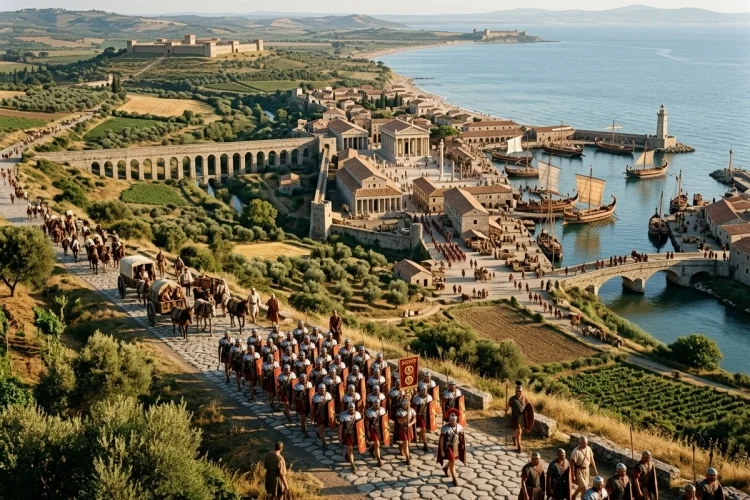
Roman roads were originally valuable military tools. They allowed troops to reach rebellious provinces or threatened frontiers more quickly, while milestones and planned routes made travel easier to organize.
However, the same roads also supported merchants, messengers, administrators, and ordinary travelers. Bridges helped routes cross rivers and difficult terrain, while ports connected inland roads with Mediterranean shipping lanes.
The sea was especially important because transporting large quantities of grain, oil, wine, stone, and other goods by ship was often more practical than moving them overland. Rome’s control of major coastal regions turned the Mediterranean into the central transportation network of its empire.
Roman soldiers frequently helped construct and maintain roads near military outposts. As a result, conquest produced infrastructure, while infrastructure made future conquest and administration easier.
This logistical system did not make travel fast by modern standards. It did, however, create a level of regional connection that few earlier Mediterranean states had achieved.
Rome Governed Through Provinces and Local Elites
The Romans could not administer every community directly from the capital. Instead, conquered territories were divided into provinces overseen by governors and other officials.
Provincial governments collected taxes, maintained order, settled legal matters, and communicated imperial commands. Roman authorities often worked with existing local elites who understood regional languages, customs, property systems, and political relationships.
This approach made the empire cheaper and easier to govern. A wealthy provincial family could maintain local influence while showing loyalty to Rome, funding public buildings, serving in government, or promoting imperial ceremonies.
Citizenship was another important tool. Roman citizenship offered legal protections, social status, and political advantages, although its meaning changed over time. It was gradually extended to individuals, communities, veterans, and provincial elites.
In 212 CE, Emperor Caracalla granted citizenship to nearly all free inhabitants of the empire. By then, being Roman was no longer limited to families living in the city of Rome or even in Italy.
Local traditions did not simply disappear. Greek remained important in the eastern provinces, regional religions continued, and communities combined Roman practices with their own identities.
Trade and Wealth Strengthened Roman Influence
Roman expansion connected productive regions with large consumer markets. Grain arrived from Egypt and North Africa, wine came from several Mediterranean areas, metals were extracted in Spain and elsewhere, and luxury goods entered through long-distance trade routes.
Standardized coinage made many transactions easier, while relatively secure shipping routes encouraged commercial movement. Goods, workers, soldiers, officials, religious beliefs, technologies, and artistic styles traveled between provinces.
Trade also extended beyond Rome’s borders. Roman merchants and consumers participated in networks linked to Arabia, East Africa, India, Central Asia, and indirectly China.
Silk, spices, precious stones, perfumes, and other luxury products reached Roman markets through several connected empires and trading communities.
This economy created impressive wealth, but its benefits were not shared equally. Imperial expansion depended heavily on taxation, land seizure, forced labor, and slavery. Enslaved people worked in households, farms, workshops, mines, and businesses throughout Roman society.
Rome’s prosperity was therefore built on both integration and exploitation. Trade connected distant regions, while imperial power controlled how resources and profits moved.
Augustus Turned Conquest Into a Stable Empire
By the first century BCE, Rome controlled vast territories, but its republican political system was breaking down. Rival generals commanded loyal armies, political violence increased, and civil wars repeatedly disrupted the state.
Julius Caesar gained extraordinary power but was assassinated in 44 BCE. More conflict followed until his adopted heir, Octavian, defeated Mark Antony and Cleopatra.
In 27 BCE, Octavian received the title Augustus. He became Rome’s first emperor in practice, although he carefully preserved the appearance of traditional republican offices.
Augustus reorganized the army, improved provincial administration, promoted building projects, and presented himself as the restorer of order after years of civil war.
His reign helped begin the period commonly called the Pax Romana, during which many parts of the empire experienced greater political stability, commercial growth, and cultural exchange.
Imperial portraits, coins, monuments, and official ceremonies helped communicate the emperor’s authority across distant provinces. Roman political power was reinforced not only by soldiers but also by symbols that reminded people who ruled the empire.
Rome still faced rebellions, border wars, succession struggles, and military defeats. Its global power was never unlimited, but Augustus created a system capable of managing the conquests accumulated during the Republic.
The Roman Empire became a global power through much more than battlefield success. Rome first built a flexible alliance system in Italy, developed adaptable armies, defeated Carthage, and gained control of the Mediterranean.
Roads, ports, provincial governments, citizenship, taxation, and trade then helped turn conquered territories into a connected imperial system. Augustus completed the transformation by replacing unstable republican competition with centralized imperial rule.
However, Rome’s success came at a high cost, including warfare, enslavement, economic extraction, and the loss of independence for conquered peoples.
To explore the story further, examine Roman maps, surviving roads, coins, military records, and museum collections. They reveal how a small Italian city created an empire whose political, legal, linguistic, and architectural influence can still be seen today.