Imagine ordering a product from another continent today. Within seconds, payment can be processed, shipping arranged, and information exchanged between businesses thousands of miles apart.
Ancient merchants obviously had no internet, cargo planes, or container ships, but they were already building surprisingly complex international trading networks.
One of the most important was the Silk Road.
The history of the Silk Road and its influence on world trade stretches across centuries and thousands of miles.
Rather than being one highway connecting China directly with Europe, it was a huge network of overland trails and maritime routes linking China, Central Asia, India, Persia, the Middle East, and the Mediterranean.
Silk may have given the network its famous name, but merchants carried much more than luxurious fabric.
Horses, spices, metals, glassware, precious stones, ceramics, and countless other goods moved between regions. Just as importantly, religions, inventions, languages, art, and scientific knowledge travelled with them.
In many ways, the Silk Road became an early foundation for the interconnected global economy we know today.
The Silk Road Was a Network, Not a Single Road
The name can be slightly misleading.
There was never one continuous road where a merchant simply packed a camel in China and rode directly to Rome. Instead, the Silk Road consisted of overlapping trade routes stretching across Eurasia.
UNESCO describes the Silk Roads as networks of land and sea routes through which goods, ideas, cultures, technologies, and beliefs circulated for more than 1,500 years.
Some routes crossed deserts and mountain passes, while others connected ports around the Indian Ocean.
Merchants usually travelled only part of the total distance.
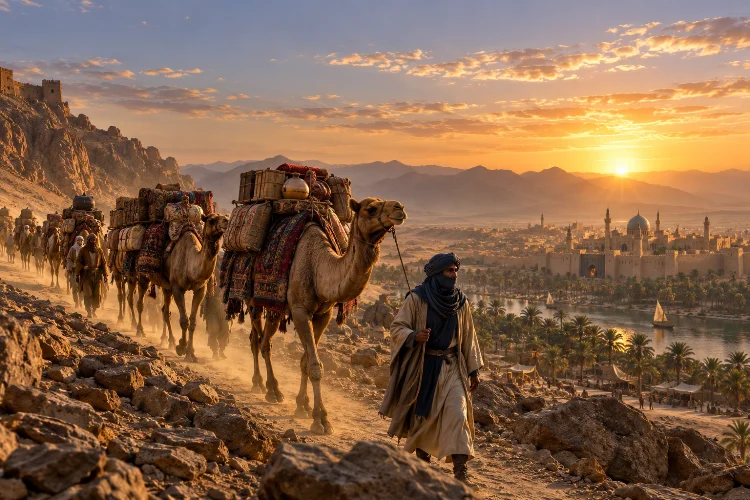
A trader might carry Chinese silk into Central Asia, sell it to another merchant, and return home with horses or precious stones. The silk could then pass through several more hands before eventually reaching Persia or the Roman world.
This relay-style system allowed products to travel enormous distances even when individual merchants never did.
How the Silk Road Began
Trade across Central Asia existed long before the Silk Road became famous, but the network expanded dramatically during China’s Han dynasty.
During the second century BCE, Han emperor Wu sent diplomat and explorer Zhang Qian westward. His journeys provided the Chinese court with valuable information about Central Asian kingdoms and helped encourage stronger political and commercial connections.
Trade between Han China, Central Asian societies, and territories farther west gradually expanded. Silk became particularly valuable in these exchanges, while China showed strong interest in Central Asian horses and other foreign goods.
UNESCO notes that trade between China and areas as far west as the Iranian Plateau flourished during the Han period.
However, many of the regions involved already had their own sophisticated trade systems.
The Silk Road therefore grew through the connection of existing networks rather than appearing suddenly as one brand-new route.
Interestingly, the term “Silk Road” itself is much newer than the routes. German geographer Ferdinand von Richthofen popularized the term Seidenstrasse in the nineteenth century.
Silk Was Valuable, but It Was Not the Only Product
Chinese silk became famous because it was light, luxurious, and highly desirable.
In the Roman world, imported silk became a prestigious material associated with wealth and fashion. National Geographic notes that Roman demand for eastern luxury goods helped support long-distance commercial connections linking the Mediterranean with Asia.
But the actual trade was far more diverse.
Goods Moving East and West
From China and other parts of Asia came silk, ceramics, spices, medicines, precious stones, paper, and other products. Goods moving eastward included glassware, textiles, metals, horses, wine, and various luxury items.
Central Asian traders played a particularly important role as middlemen.
This is one reason the Silk Road should not be viewed simply as trade between “China and Europe.” India, Persia, Arabia, Central Asia, and many smaller kingdoms were active participants with their own products, markets, and merchant communities.
The system was truly multiregional.
Trading Cities Became Early International Hubs
Long-distance trade required places where merchants could rest, feed animals, exchange goods, obtain information, and prepare for the next difficult stage of the journey.
Cities along the routes flourished because of this demand.
Samarkand and Bukhara in Central Asia became famous commercial centers. Other settlements across China, Persia, India, Arabia, and the Mediterranean connected caravan and maritime networks.
UNESCO notes that Silk Roads cities were more than marketplaces. Merchants met scholars, teachers, religious figures, craftspeople, and travellers there, turning many trading centers into important places of intellectual and cultural exchange.
This resembles modern commercial hubs in an interesting way.
Cities such as Singapore, Dubai, Rotterdam, and Hong Kong became globally important partly because they connect wider networks of transport and trade. Ancient Silk Road cities operated on a much slower scale, but the basic economic principle was similar.
A strategic position between major markets could create enormous commerical opportunities.
The Silk Road Traded Ideas as Well as Products
Perhaps the Silk Road’s greatest influence had nothing to do with silk.
People travelling through the network carried beliefs, languages, art styles, technologies, and scientific knowledge.
Buddhism provides one of the clearest examples.
Merchants and monks helped Buddhism spread from South Asia through Central Asia and eventually into China. Buddhist monasteries developed near important trading centers, while artistic traditions from India, Greece, Persia, and Central Asia influenced Buddhist imagery.
The Metropolitan Museum of Art highlights the close relationship between trade networks and the spread of Buddhism across Central Asia.
Christianity, Zoroastrianism, Manichaeism, and later Islam also travelled through parts of these networks.
Technologies moved too.
Paper-making knowledge eventually spread westward from China. Agricultural products, artistic techniques, medical knowledge, and scientific ideas also crossed borders.
The Silk Road therefore created something similar to an ancient information network. Goods had value, but so did knowlege.
The Silk Road Helped Create an Early Global Economy
Modern globalization involves interconnected production, transportation, finance, communication, and consumer demand.
The Silk Road did not operate on today’s enormous scale, but several familiar economic patterns were already visible.
Merchants responded to demand in distant markets. Political stability could make trade easier, while war or instability could make routes dangerous. Cities prospered by providing transportation, storage, accommodation, security, and financial services.
Products could also increase dramatically in price as they moved through multiple intermediaries.
Chinese silk purchased near its place of production might pass through several merchants before appearing in Mediterranean markets. Every stage involved transportation costs, risk, taxes, storage, and profit margins.
In other words, ancient traders were already dealing with concepts resembling modern supply chains.
The Kushan Empire offers a useful example. Its strategic position across parts of modern Afghanistan, Pakistan, Uzbekistan, and northern India gave it access to major overland routes and maritime connections, contributing to extensive merchant activity and urban prosperity.
Trade Also Carried Disease and Risk
Global connections bring advantages, but they can also spread problems.
The Silk Road was no exception.
Merchants, animals, armies, and travellers moved between regions, creating pathways through which infectious diseases could spread.
Historical research has linked Eurasian trade networks with several major disease outbreaks, although the exact routes and mechanisms for individual epidemics remain debated.
This darker side of connectivity offers an important lesson.
Greater movement means more opportunities for commerce and cultural exchange, but it also creates networks through which crises can travel.
Modern economies experienced something similar during global disease outbreaks when interconnected transportation systems helped illnesses cross borders quickly.
Ancient trade moved far more slowly, but the underlying relationship between mobility and disease transmission was already present.
The Mongol Era Revived Long-Distance Trade
One of the most important periods in Silk Road history came during the expansion of the Mongol Empire in the thirteenth and fourteenth centuries.
Mongol rule brought vast territories across Eurasia under related political authorities. Although Mongol conquests were often extremely destructive, the resulting political networks later helped facilitate movement across large areas.
Merchants, diplomats, missionaries, artisans, and travellers could move between regions with greater frequency.
This period is famously associated with travellers such as Marco Polo, whose accounts introduced many European readers to descriptions of societies across Asia.
Trade was not flowing in only one direction, either. Goods, technologies, religious traditions, artistic styles, and diplomatic information moved through interconnected societies.
The result was one of the most influencial periods of Eurasian exchange before modern oceanic globalization.
Why the Traditional Silk Road Declined
The Silk Road did not simply close on one specific day.
Its importance changed gradually as political conditions and transportation technologies evolved.
The fragmentation of major empires increased insecurity along some overland routes. Meanwhile, maritime trade became increasingly attractive because ships could carry much larger quantities of goods than camel caravans.
The Metropolitan Museum of Art notes that disruptions following the fragmentation of the Mongol Empire and political changes after the Ottoman conquest of Constantinople in 1453 contributed to European efforts to find direct sea routes to Asian markets.
Portuguese navigators eventually developed routes around Africa to the Indian Ocean, while Spanish-sponsored voyages searched westward for access to Asia.
These maritime expeditions transformed global commerce.
The Atlantic, Indian, and Pacific oceans gradually became parts of an increasingly integrated worldwide trading system.
In that sense, the search for alternatives to older Eurasian trade networks helped shape the next major era of globalization.
How the Silk Road Influenced Modern World Trade
The Silk Road disappeared as a dominant trading network, but many of the ideas behind it remain surprisingly familiar.
Modern world trade still depends on transportation corridors, strategic ports, commercial cities, political stability, international agreements, and reliable communication.
Supply chains still involve multiple intermediaries connecting producers with consumers thousands of miles away.
Cultural exchange still follows commercial exchange as well. Popular foods, technologies, languages, fashion, entertainment, and ideas move alongside international business.
The biggest difference is speed.
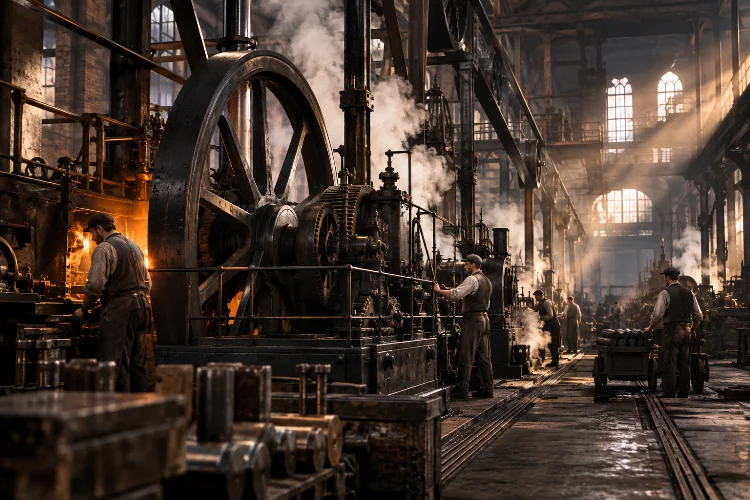
A lenghty caravan journey that once required months can now be replaced by air freight in days, digital communication in seconds, or container shipping on predictable schedules.
But the basic motivation remains unchanged: societies have resources, products, and knowledge that others want.
The Silk Road demonstrated how powerful those connections could become.
The history of the Silk Road and its influence on world trade is about much more than merchants carrying Chinese silk across deserts. It was a massive network connecting societies throughout Asia, the Middle East, Africa, and Europe.
Through those connections, people exchanged luxury goods, everyday products, religions, technology, artistic traditions, scientific knowledge, and sometimes disease.
Trading cities grew into multicultural centers, while merchants developed networks that resembled early versions of modern international supply chains.
Eventually, maritime routes replaced many traditional overland connections, helping create an even more global trading system.
The next time you buy something produced on another continent, consider the history behind international commerce.
Today’s global economy may use ships, aircraft, and digital platforms, but the desire to connect distant markets has existed for thousands of years.